Nylon resin supplier: PA6 and PA66, unfilled, heat-stabilized and impact-modified
We source PA6 and PA66 in unfilled, lubricated, heat-stabilized, impact-modified and flame-retardant grades for molding, film, monofilament, profile and compounding, from one gaylord (about 1,000 to 1,600 lb) to truckloads. Send the grade you run, or its type, viscosity and additive package, and a polymer chemist reviews it and quotes a match or a matched alternative.
One gaylord to a truckload · Every prime lot from our suppliers ships with a COA
Request a QuoteShop-floor numbers
- Drying
- About 80°C / 176°F, 2–6 h
- Melt temp
- PA6 250 to 280°C / 482 to 536°F · PA66 280 to 300°C / 536 to 572°F
- Mold temp
- 40–100°C / 104–212°F
- Shrinkage
- PA6 0.8–1.5% · PA66 1.0–1.8%
- Watch for
- Splay; wet parts that look fine but are brittle
- Grades
- PA 6 and PA 66, unfilled · Glass-filled (13–50% GF) · Impact-modified / toughened · Heat-stabilized
Typical values; confirm against the grade’s data sheet. One gaylord to a truckload; bulk by arrangement · Supplier COA on every prime lot · Ships to the U.S. and Canada.
 View example
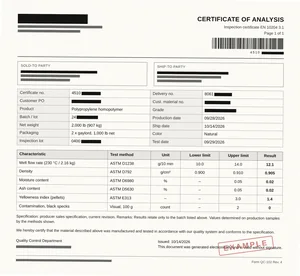
See what one looks like and what to check: lot number, melt flow, density, test methods. Example shown is a PP COA; a nylon COA also lists moisture and relative viscosity. How to read a COA
The short answer
Unfilled and toughened PA6 and PA66 are the default choice for tough, wear-resistant moving parts that see oil, grease or fuel. Pick PA66 when the part runs hotter and PA6 when surface finish and easier molding matter more. The thing that most often goes wrong is moisture: pellets molded wet lose strength without showing it, and finished parts grow as they pick up water from the air.
PA66 tight or on allocation? See PA66 alternatives and how to switch, or set up a backup source on the grade you run now. Already holding a notice? See the allocation and force majeure plan.
Grades we source
Tap a grade to add it to your quote request.
About Nylon (Polyamide, PA 6 & PA 66)
Nylon offers an excellent balance of strength, toughness, fatigue and wear resistance, and chemical resistance to fuels and oils. Glass reinforcement dramatically raises stiffness and heat capability. Nylon absorbs moisture: about 2.5–3.5% at 50% relative humidity and 8–10% when saturated. Parts grow and stiffness falls by more than half as they condition, while toughness rises. Design and test in the conditioned state. Heat-stabilized and specialty grades address demanding environments.
Common applications
- Under-hood automotive components
- Gears, bearings and bushings
- Electrical connectors and housings
- Power-tool and appliance parts
- Industrial and structural components
Typical properties
| Impact strength | Good (toughened: high) |
|---|---|
| Heat (HDT @ 1.8 MPa) | ~55–65°C PA6, ~70–90°C PA66 unfilled · ~205°C PA6 GF30 · ~240–255°C PA66 GF30 |
| Clarity | Opaque |
| Chemical resistance | Good (fuels/oils) |
| Relative cost | Moderate |
Property ranges are general guidance and vary by grade and supplier; a polymer chemist reviews the spec against the data sheet and COA.
Full data sheet values: Nylon 66 properties · Nylon 6 properties
Which grade to ask for
Most nylon specs come down to three things: the base polymer, the viscosity and the additive package.
| Grade type | Use it for | Watch out for |
|---|---|---|
| PA66, unfilled general purpose | Gears, bushings, cable ties, fasteners and fittings | A narrow melt window just above its 260°C melting point; parts grow as they condition |
| PA6, unfilled | Housings, clips and parts where gloss and easier molding matter | Gives up heat resistance sooner than PA66 and takes on water a little faster |
| Heat-stabilized (HS) | Under-hood and hot-air parts that age at temperature | Heat-aging results differ a lot between stabilizer packages, so match the package, not just the letters HS |
| Impact-modified / toughened | Parts that must survive impact dry as molded or in the cold | Lower stiffness and heat deflection than the base grade |
| Flame-retardant | Electrical housings, connectors and breaker parts | Halogenated and halogen-free grades are not interchangeable; UL recognition is grade-specific and color-specific |
| Lubricated / mold-release | Thin walls, fast cycles, cable ties | The lubricant can interfere with painting, printing and bonding |
| High-viscosity extrusion grades | Film, monofilament, rod and profile | Too stiff to fill most injection molds |
Typical starting points. Grades vary, so confirm on the data sheet for the exact grade.
Buying to a spec? See PA66 GF30 spec and ordering, unfilled nylon 6, unfilled nylon 66.
Grade finder: start from what you make
Pick your process, find the row for your product, and tap Request a Quote to add it to the form.
| Product | Grade family | Typical window | Put on the RFQ | Quote |
|---|---|---|---|---|
| Gears, bushings, rollers and wear parts | PA66 unfilled, often lubricated or nucleated | Low to medium viscosity for molding: for PA66, the formic-acid RV by ASTM D789 that the grade’s data sheet lists, or VN about 150 mL/g for an easy-flow grade and about 170 mL/g for a medium-viscosity grade by ISO 307 (0.5% in 96% sulfuric acid). Melting point about 260°C / 500°F | Lubricated or not, nucleated or not, and whether you need an internal lubricant such as PTFE or MoS2, which makes it a compound. Best plastic for gears › | |
| Housings, clips, handles and power-tool parts | PA6 unfilled, general purpose | Low to medium viscosity: about FAV 35 to 55 by ASTM D789 (formic acid). Melting point about 220°C / 428°F | Natural or black, lubricated or not, and the part’s highest service temperature, since PA6 gives up stiffness sooner than PA66 when hot. Nylon 6 vs. nylon 66 › | |
| Snap fits, sporting goods, ski and bike parts, impact housings | Impact-modified (toughened or super-tough) PA6 or PA66 | Super-tough grades reach notched Izod values many times those of unmodified PA66, which lists about 5.5 kJ/m² by ISO 180/1A at 23°C / 73°F, dry as molded. Toughened grades sit in between. Compare grades on the same test method and check the grade’s data sheet | Impact at your lowest service temperature, dry as molded and conditioned, and the stiffness and heat deflection you give up for it. Best plastic for impact › | |
| Food-contact and potable-water parts | PA6 or PA66 grade with food-contact documents | Viscosity as for the base grade, by the producer’s method. Nylon resins for food contact fall under 21 CFR 177.1500; the producer’s letter must cover the exact grade, color and use conditions | The producer’s FDA letter, and an NSF/ANSI/CAN 61 listing if the part touches drinking water. Both are tied to the exact grade and color. FDA food-contact resin › | |
| Clips, fasteners, cable carriers and air-path parts near the engine | PA66 heat-stabilized, unfilled or toughened | Injection viscosity as above. Ask for long-term heat-aging data, for example tensile strength retained after 1,000 hours or more at 150°C / 302°F or the temperature your OEM spec names | The heat-stabilizer type (copper-halide or organic) and the OEM material spec number. Black copper-stabilized grades are common under the hood. Automotive › | |
| Radiator end tanks, coolant and glycol parts | PA66 GF30 or GF35, heat- and hydrolysis-stabilized | Glass about 30–35% by ash (ISO 3451-4 or ASTM D5630). Viscosity by the producer’s method | Hydrolysis resistance in hot glycol at your temperature and hours, and the OEM spec. This is a glass-filled compound, so see the glass-filled page. PA66 30% glass › | |
| Structural brackets and housings that must stay stiff | PA6 or PA66, 13–50% glass | Glass level by ash on every COA. Heat deflection rises sharply with glass, about 205°C / 401°F for PA6 GF30 and about 240–255°C / 464–491°F for PA66 GF30 at 1.8 MPa | Glass level, heat stabilization and whether the part runs hot enough to need PA66 rather than PA6. Glass-filled nylon › | |
| Cable ties | PA66 unfilled, lubricated, often heat-stabilized | Injection viscosity as above. Ties are usually UL 94 V-2 at the stated thickness, and their toughness depends on moisture taken up after molding | The cable-tie listing tied to the grade and color, UV-stabilized black for outdoor ties, and how you condition ties after molding. Electrical and electronics › | |
| Connectors, terminal blocks and breaker parts | PA66 or PA6, flame-retardant, unfilled or glass-filled | UL 94 V-0 or V-2 at the thickness on the grade’s UL card, plus CTI and RTI from the same listing. Viscosity by the producer’s method | Halogen-free or halogenated, the UL file and color, and glow-wire values (IEC 60695-2-12 and -13) if the part goes into an appliance. Best plastic for connectors › | |
| Appliance and power-tool parts that must pass glow-wire | PA66 or PA6 FR, or heat-stabilized general purpose | Glow-wire flammability and ignition values by IEC 60695-2-12 and -13 at the part thickness, as listed by the producer | Which glow-wire values your appliance standard requires, whether the grade must be halogen-free, and whether your spec also excludes halide (copper-iodide type) heat stabilizers, which some electrical customers avoid near metal contacts. Appliances › | |
| Cast and blown film for meat, cheese and barrier packaging | PA6 film grade, or PA6/66 copolymer for shrink film | High viscosity: about FAV 85–135 by ASTM D789 (formic acid). One producer’s film grades read FAV 85, 120 and 135; the FAV 135 grade has a relative viscosity of about 3.75 in 96% sulfuric acid | Lubricated or not, extractables (residual caprolactam) on the COA, and the producer’s FDA letter under 21 CFR 177.1500. Film, bags and liners › | |
| Monofilament, brush bristles and trimmer line | PA6 or PA6/66 copolymer, medium to high viscosity; PA612 or PA610 for toothbrush, cosmetic and paint-brush bristles | Medium viscosity and up: about FAV 55 and higher by ASTM D789, or a relative viscosity in 96% sulfuric acid on European and Asian sheets, with higher-viscosity grades used for high-strength filament | Viscosity spread lot to lot, which drives draw ratio and line breaks, and heat or UV stabilization for outdoor line. Nylon fiber and monofilament resin › | |
| Rod, slab, tube and profile | PA66 or PA6, high viscosity extrusion grade | High viscosity, well above injection grades, by the producer’s method (formic acid RV, FAV or VN). Cast nylon stock shapes are made from monomer, not from pellets | Melt strength for your die, heat stabilization, and whether the shapes are machined, since stress relief and moisture change dimensions. Nylon 66 properties › | |
| Pneumatic tubing and cable jacketing | PA6 or PA66 extrusion grade, often plasticized or heat-stabilized | High viscosity by the producer’s method. For air-brake and fuel lines, nylon 11 or 12 is the usual choice because it absorbs far less water | The tubing standard you build to, and whether PA11 or PA12 is already written into it. Nylon 11 and 12 › | |
| Base resin for glass, mineral, FR and color compounds | PA6 or PA66, low to medium viscosity, unlubricated | Low to medium viscosity by the producer’s method, for example PA6 about FAV 35 to 55. Moisture as shipped matters because the extruder vents have to remove it | Viscosity window, moisture spec, and whether the base is unlubricated and unstabilized so your own package goes in. Compounders › | |
| Fiber and carpet yarn (BCF) | PA6 or PA66 fiber grade | Medium viscosity with a tight lot-to-lot window: PA6 carpet BCF about FAV 55 and up by ASTM D789, held to a tight window around the grade value; textile yarn grades by the producer’s method | Viscosity window, extractables, TiO2 level (bright, semi-dull or full-dull), amine end groups for dye level, and the dyeability your yarn needs. Nylon fiber and monofilament resin › |
These windows are typical published ranges to start the conversation. Viscosity scales are not interchangeable, so confirm against the data sheet for the grade you run and let a chemist check any alternative before you switch.
Processing notes
- Drying. Use a dehumidifying dryer at about 80°C / 176°F: 2–6 hours for PA6, 2–4 hours for PA66 from a fresh bag. Published moisture targets run from 0.03% to 0.2% depending on the producer. Do not over-dry: it can yellow the resin and raise melt viscosity. See the drying chart for other resins.
- Melt temperature. PA6 about 250 to 280°C / 482 to 536°F. PA66 about 280 to 300°C / 536 to 572°F. Keep barrel residence under about 10 minutes.
- Mold temperature. PA6 40–100°C / 104–212°F (producers disagree on where in that range). PA66 60–100°C / 140–212°F. A warmer mold gives more crystallinity and steadier dimensions.
- Shrinkage. Data sheets show about 0.8–1.5% for PA6 and 1.0–1.8% for PA66, but a constrained real part can shrink much less (one producer shows an unfilled PA66 part at about half its plaque value), so size the tool from the producer’s design data or a prototype, not the plaque number. Parts then grow as they absorb water.
- Regrind. Many molders start at 15–25% same-grade regrind. Dry it at least as long as virgin pellets. Wet regrind hydrolyzes in the barrel, and over-dried regrind yellows.
- Most common defect. Splay from wet resin, and the worse case: parts molded wet that look fine but are brittle. Check pellet moisture before you change the process.
What to put on the purchase order
- PA6 or PA66, and the viscosity. Nylon is often specified by viscosity number or relative viscosity rather than melt flow, so give whichever your data sheet uses, with its test method.
- The full additive package: heat stabilized, lubricated, nucleated, UV stabilized, impact modified. Grafted elastomers used to toughen nylon are covered in maleic anhydride grafted polyolefins.
- Color: natural, black or a custom match. Black for outdoor parts should be a UV-stabilized black.
- Moisture as packed, and sealed moisture-barrier packaging (lined bags or lined gaylords). Ask for the moisture value on the COA.
- Flame rating: the UL 94 rating and the thickness it applies at. UL recognition is grade-specific and color-specific, so check the grade’s listing on UL Product iQ.
- Food contact: ask for the producer’s FDA letter for the exact grade.
- COA values to check on arrival: moisture, viscosity or melt flow, and color.
Prime, wide-spec, reprocessed or recycled
| Material | What it is | When it makes sense | What to ask for |
|---|---|---|---|
| Prime | The producer’s first-quality resin, in spec, sold under its grade name with a lot COA, in the producer’s sealed packaging. | Any part with an OEM spec, a UL listing, food contact or a customer approval. | The grade name, a lot COA with viscosity and moisture, and the UL or FDA documents for that grade and color. |
| Wide-spec or off-grade | Made by the producer but outside the published window, often viscosity or color, or transition material. Sold without the grade name. | Non-critical parts and compounding feed that tolerate some variation. | Which property is off and by how much, the viscosity and moisture measured on each lot, and PA6 or PA66 confirmed. |
| Reprocessed (repro) | Industrial scrap such as molding scrap, fiber waste or film trim, ground, dried, melted and pelletized again. | Black or dark parts and products that allow a set share of repro. | The source stream, PA6 or PA66, viscosity range lot to lot, glass or ash if filled scrap may be mixed in, and moisture as shipped. |
| PIR | Post-industrial recycled: clean manufacturing scrap that never reached a consumer, such as fiber or film waste. | Recycled content with more consistency than PCR. | The source process, and whether your customer counts PIR toward its recycled-content target. See prime vs. off-grade. |
| PCR | Post-consumer recycled nylon, for example from carpet or fishing nets, sorted, cleaned and pelletized. | When your customer asks for recycled content and the part allows some variation. | Viscosity window, ash, color and odor, and data from the recycler on lot consistency. See recycled resin. |
| Broker or unknown origin | Material sold with no producer lot number, in plain or re-labeled packaging, or offered as prime far below market. | Rarely. With PA66 tight, mixed, repro or PA6 material has been sold as prime PA66. | The producer’s lot number on the original label and the original COA. A quick DSC test shows the melting point, about 220°C / 428°F for PA6 and about 260°C / 500°F for PA66. See how to vet a resin supplier. |
Checking the COA when the lot arrives
- Lot number. The lot on the COA matches the label on every gaylord or bag, and the liner is the producer’s sealed liner.
- Moisture as shipped. The COA moisture is inside the producer’s spec, commonly 0.2% or lower and as low as 0.06–0.15% maximum for some grades, measured by Karl Fischer (for example ASTM D6869). If it is high, or the liner was opened, dry before molding no matter what the label says.
- Viscosity by the right method. Check the value against your window on the same scale: RV or FAV by ASTM D789 (formic acid) or VN by ISO 307 (usually 96% sulfuric acid). The scales do not convert one for one, and an MFR on a nylon COA depends on how dry the sample was.
- Glass or ash for filled grades. Glass content by ash (ISO 3451-4 or ASTM D5630) inside the stated tolerance. A few points off changes stiffness, shrink and part weight.
- Type and package. PA6 or PA66 matches your PO, and lubricated, heat-stabilized, nucleated, toughened or FR status has not changed. A heat-stabilizer change shows up later as heat-aging failures, not at the press.
- Color and extractables. Natural pellets should not be yellow. For PA6 film and fiber grades, check extractables (mostly residual caprolactam), which affects film and spinning.
- Melting point if in doubt. If a lot runs differently, a DSC melting point separates PA6 (about 220°C / 428°F) from PA66 (about 260°C / 500°F) and catches a mix-up.
- Keep a sealed retain. Seal a small sample of each lot in a moisture-barrier bag. See the incoming inspection checklist and what a COA is.
Adding a second source without stopping the line
- Write down what you run now. The grade, its data sheet, three to six recent COAs with actual viscosity and moisture values, your drying and process settings, and every approval tied to the grade (OEM spec, UL file, FDA letter, customer approval).
- Match on paper first. A polymer chemist compares PA6 or PA66, viscosity on the same scale, heat-stabilizer type, lubricant, nucleation, impact modifier, FR package and documents, and tells you what differs.
- Sample, then a production trial. Run one gaylord next to your current grade. Compare parts both dry as molded and after conditioning, because nylon properties and dimensions change as parts take up water. Check heat aging if the part runs hot.
- Get approvals before volume. Same polymer from another producer still usually needs customer notification, and often a PPAP or UL review. A switch between PA66 and PA6 is a material change and needs full requalification.
- Keep the second source active. Buy a small regular volume and trend its COAs, so it is ready the next time PA66 goes on allocation. See how to qualify a second resin source.
Want a chemist to compare a second source with what you run now? Send the grade and recent COAs through the quote form or an RFQ package.
When to consider something else
- If parts grow or lose stiffness in wet service, look at nylon 11 and 12 or polyketone.
- If you need more stiffness and heat deflection, look at glass-filled nylon. When glass-filled PA66 runs out of heat, see PPA vs. nylon 66.
- If tight tolerances and low friction matter more than toughness, see acetal vs. nylon.
- If the part is electrical and must hold its size in humid air, see glass-filled nylon vs. PBT.
How nylon prices are set
Nylon price starts with its building blocks. PA6 is made from caprolactam, which is made mostly from benzene by way of cyclohexane or phenol, with ammonia in the process. PA66 is made from adipic acid and hexamethylenediamine (HMD). Adipic acid also comes from benzene through cyclohexane. HMD is made from adiponitrile (ADN), and only a few companies in the world make ADN, from butadiene or acrylonitrile. So benzene drives both nylons, natural gas (through ammonia and hydrogen) adds to the cost, and PA66 also depends on a short list of ADN plants.
Unlike PE and PP, nylon has no monthly industry-wide contract settlement. Large buyers usually buy on annual or quarterly contracts, often with a formula tied to benzene or other raw materials, and producers announce increases by letter. Smaller buyers pay distributor prices that follow those moves with a lag. Compounds are priced as base polymer plus glass, additives and compounding cost, so a GF30 or FR grade does not track the base resin one for one. Price reporting services such as ICIS and S&P Global Commodity Insights (Platts) publish U.S. nylon price reports by subscription.
Supply history matters more for PA66 than for most resins. Because so few plants make ADN, an outage, a storm or a force majeure at one of them can tighten PA66 across the market at once. PA66 has tightened more than once when ADN plants went down, so check the current supply picture before you plan around it. PA6 draws on caprolactam from many producers, so it rarely tightens at the same time. See PA66 shortage alternatives.
We do not post prices. Every quote is for a specific grade, quantity, package and ship-to city. See how resin is priced for the mechanics and the resin market notes for which way nylon is moving this month.
What order size does to the price
| How you buy | Typical size | Why the price per pound differs |
|---|---|---|
| Truckload of gaylords | About 40,000–45,000 lb, about 26–30 boxes | Closest to the producer’s or distributor’s best boxed price. Freight per pound is lowest because the truck is full. |
| Multiple gaylords, LTL or partial truckload | 2 to about 18 gaylords | Freight per pound runs several times a full truck. Terminal handling, liftgate and fuel surcharges add up. |
| Single gaylord | About 1,000–1,600 lb | The highest freight per pound for boxed resin. The seller’s fixed cost of each order (paperwork, COA, credit, handling) is spread over one box. |
| Bags or a pallet of bags | 55 lb (25 kg) moisture-barrier bags | The highest price per pound. Common for specialty, colored and imported grades, and for samples and trials. |
| Bulk truck or railcar | By arrangement only | Rare for nylon. Producers ship bulk by agreement to a few very large fiber, film or compounding plants with dry silos. Most nylon, including most truckload volume, ships boxed or bagged. |
Freight to your dock, FOB versus delivered terms, imported versus domestic resin, the additive package and prime versus wide-spec can move the price as much as order size, so send your ship-to city with every request.
Ways to lower the cost: buy a full truckload instead of single gaylords, tell us imported resin is OK, or ask about surplus lots and recycled grades if your part allows. See nylon price per pound and how resin is priced.
Packaging and lead times
| Package | Typical net weight | Notes |
|---|---|---|
| Moisture-barrier bag | 55 lb (25 kg) | Multiwall or foil-laminate bag, heat-sealed. Often 40–55 bags per pallet. Use the whole bag once opened, or reseal it. |
| Gaylord with sealed barrier liner | About 1,000–1,600 lb | A heat-sealed foil or multilayer liner keeps the resin at its as-shipped moisture. Unfilled nylon has a bulk density of about 38–45 lb/ft³, so boxes often net in the upper half of the range. Check net weight on the quote. |
| Octabin | About 1,000 kg (2,205 lb) | Common for imported nylon and some producers’ standard pack. Same rules: sealed liner, and close it after every draw. |
| Bulk truck or railcar | By arrangement only | Rare. Only for plants with dry-air or inert-gas silos, by agreement with the producer. Ask how the material is protected from moisture in transit. |
Lead time is confirmed with your quote, and we do not promise a ship date until the source has confirmed it. Unfilled PA6 and PA66 in natural or black are usually the quickest to ship when they sit packaged in a supplier’s inventory. Heat-stabilized, flame-retardant, toughened and custom-color grades are often made to order on a producer’s or compounder’s schedule, which can take weeks. Imported grades add ocean transit and customs time.
When PA66 goes on allocation, contract customers are served first and spot supply dries up, so lead times stretch for everyone. Tell us the date you need resin on your floor and how much you have on hand, and we will tell you what is realistic. See what to do under allocation or force majeure and gaylord vs. LTL vs. truckload.
Named grades with their own page
Typical data, close alternatives to qualify and buying notes for common named grades in this family: Durethan BKV30H2.0 · Grivory GV-6H · Ultramid A3EG6 · Ultramid A3K · Ultramid A3WG6 · Ultramid B3EG6 · Ultramid B3S · Ultramid B3WG6 · Vydyne 21SPC · Zytel 101L · Zytel 103HSL · Zytel 70G33HS1L · Zytel 70G33L · Zytel ST801. Running a grade that is not listed? Send it and a polymer chemist will check it.
Common questions
Does nylon need to be dried before molding?
Yes. Dry PA6 and PA66 at about 80°C / 176°F in a dehumidifying dryer, 2–6 hours for PA6 and 2–4 hours for PA66 from a fresh bag. Wet nylon breaks down in the barrel and can make brittle parts with no visible defect. Feed straight from the dryer to the press.
What is the difference between PA6 and PA66?
PA66 melts about 40°C higher, holds stiffness better when hot and absorbs a little less water. PA6 processes over a wider window. For most parts that do not run hot, either works. See nylon 6 vs. nylon 66.
Why do nylon parts change size after molding?
Nylon absorbs water from the air, and the part grows as it does. In a well-molded part of moderate wall thickness, growth from moisture outweighs the extra shrinkage from crystallization. Measure and design to the conditioned size, not the size out of the press.
Is nylon food safe?
Some PA6 and PA66 grades are made for food contact, but compliance belongs to the exact grade, not to nylon as a family. Ask for the producer’s FDA letter for the grade and color you will run, and check that it covers your food type and temperature.
What is the price of nylon 66 per pound?
We do not post a price because there is no single one. PA66 prices follow benzene, butadiene and the few plants that make its key intermediate, plus producer increases, and your price also depends on the grade, additive package, quantity, packaging and freight to your dock. Many online figures are index averages, Asian export prices or regrind offers, not prime pellets delivered to a U.S. plant. See the resin market notes for direction, and send your grade, quantity and ship-to city for a firm quote.
What is the minimum order for nylon resin?
One gaylord, about 1,000 to 1,600 lb. There is no truckload minimum. Some specialty grades come in 55 lb (25 kg) bags. To qualify a production grade, ask about a sample of about 50 lb, available upon credit approval.
Can I use PA6 instead of PA66, or the other way around?
Often, but it is a material change. PA6 melts about 40°C / 72°F lower, loses stiffness sooner when hot, takes up a little more water and runs at lower melt temperatures. It also shrinks less (about 0.9% against 1.5 to 1.8% for PA66 on BASF test plaques), so parts often come out a different size in the same tool. PA6 is a common substitute for PA66 in parts near room temperature when PA66 is short; PA66 in a PA6 tool needs a hotter melt and a check of shrink and gates. Trial it, measure first parts, and requalify any OEM, UL or food approval. See PA66 alternatives.
Why is nylon specified by relative viscosity instead of melt flow?
Nylon’s melt flow changes with how much water is in the sample: wet nylon breaks down in the plastometer and reads high, and very dry nylon can keep polymerizing and read low. A solution viscosity test dissolves the pellets in formic or sulfuric acid, so moisture does not skew it. U.S. data sheets often give RV or FAV by ASTM D789, and European sheets give VN by ISO 307, usually in sulfuric acid. Compare grades on the same scale.
Does nylon come dry enough to mold straight from the bag?
Often yes, if the bag or liner is sealed and freshly opened. Producers pack nylon dry in moisture-barrier bags or sealed gaylord liners, and some data sheets say no drying is needed from a sealed container. Once opened, pellets take up water from the air within hours, so close the liner after every draw and dry anything that sat open. Check the moisture on the COA, and measure it if you are unsure.
Related pages (27)
Talk to a polymer chemist
Have a grade on a print, a bag label, or just a part you need to make? Send what you have.
- Send the grade, a callout or a photo of the bag label.
- We check it, and suggest a matched alternative if it is hard to get.
- We aim to quote within one to three business days, from one gaylord to a railcar.
Tell us the Nylon (PA) grade you run now
A polymer chemist reviews every request, then matches your grade or finds a matched alternative and prices it.
What to send for an accurate quote
- The grade name, from any supplier, or a data sheet
- Color (natural, black or a custom match)
- Fill type and percentage, if any
- Viscosity (RV, FAV or VN, with the test method) or melt flow, if you know it
- Quantity for this order and what you use in a year
- Ship-to ZIP or postal code