
Typical ranges for general-purpose grades, dry as molded, from published data sheets (ASTM methods; Izod notched at 3.2 mm). Bars compare the middle of each range between the resins you picked. Individual grades vary; a polymer chemist can check a specific grade against your requirements.
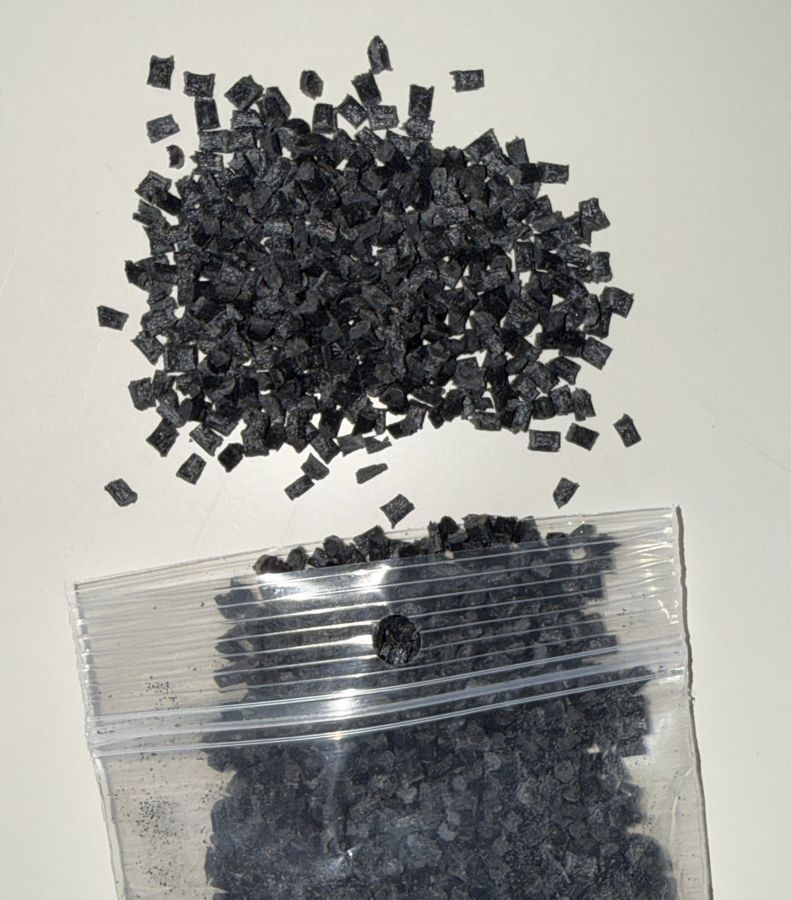 Surplus lot · Available nowPBT/PET, 55% glass-filled, black120,000 lb of prime material at 65% off typical price. Left over from a canceled automotive program.See the lot
Typical properties of 29 plastics
The full data behind the tool, in metric units. Tap a resin for grades, applications and a quote.
| Resin | Density, g/cm³ | Tensile, MPa | Flex modulus, GPa | Notched Izod, J/m | HDT 1.8 MPa, °C | Water 24 h, % | Shrinkage, % | Drying |
|---|---|---|---|---|---|---|---|---|
| PP homopolymer | 0.90–0.91 | 31–37 | 1.2–1.8 | 20–50 | 50–60 | 0.01–0.03 | 1.0–2.0 | Not needed |
| PP impact copolymer | 0.90–0.91 | 20–28 | 0.9–1.4 | 60–500 | 45–55 | 0.01–0.03 | 1.0–2.0 | Not needed |
| HDPE | 0.940–0.965 | 20–32 | 0.8–1.5 | 20–200 | 40–55 | 0.005–0.010 | 1.5–3.0 | Not needed |
| LDPE | 0.915–0.930 | 8–15 | 0.15–0.35 | No break | Not usually rated | 0.005–0.010 | 1.5–3.0 | Not needed |
| LLDPE | 0.915–0.940 | 10–25 | 0.2–0.6 | No break | Not usually rated | 0.005–0.010 | 1.5–3.0 | Not needed |
| Polystyrene (GPPS) | 1.04–1.05 | 35–50 | 3.0–3.3 | 15–25 | 75–90 | 0.03–0.10 | 0.3–0.6 | Not needed |
| HIPS | 1.03–1.05 | 18–30 | 1.6–2.4 | 60–150 | 70–85 | 0.05–0.10 | 0.4–0.7 | Not needed |
| ABS | 1.03–1.07 | 35–50 | 2.0–2.6 | 150–400 | 80–100 | 0.20–0.40 | 0.4–0.7 | Yes (cosmetic) |
| ASA | 1.05–1.08 | 35–50 | 1.9–2.5 | 100–400 | 80–95 | 0.20–0.40 | 0.5–0.9 | Yes (cosmetic) |
| SAN | 1.07–1.08 | 65–80 | 3.4–3.8 | 15–30 | 90–100 | 0.15–0.30 | 0.3–0.7 | Mild |
| Polycarbonate (PC) | 1.20 | 60–70 | 2.2–2.5 | 600–900 | 124–132 | 0.12–0.15 | 0.50–0.75 | Yes (critical) |
| PC/ABS | 1.10–1.20 | 45–60 | 2.0–2.6 | 400–700 | 85–110 | 0.20–0.30 | 0.5–0.9 | Yes (critical) |
| Acrylic (PMMA) | 1.18–1.19 | 60–75 | 2.9–3.3 | 15–25 | 85–100 | 0.20–0.40 | 0.2–0.7 | Yes |
| Nylon 6 (PA6) | 1.13 | 70–85 | 2.4–2.9 | 40–70 | 55–65 | 1.30–1.90 | 0.8–1.5 | Yes (critical) |
| Nylon 66 (PA66) | 1.14 | 75–90 | 2.6–3.0 | 35–60 | 70–90 | 1.00–1.50 | 1.0–1.8 | Yes (critical) |
| Nylon 6, 30% glass | 1.35–1.37 | 150–185 | 8.0–9.5 | 100–140 | 200–210 | 0.90–1.20 | 0.30–0.75 | Yes (critical) |
| Nylon 66, 30% glass | 1.37–1.39 | 170–200 | 8.5–10.0 | 100–130 | 235–250 | 0.70–1.00 | 0.5–1.1 | Yes (critical) |
| Acetal copolymer (POM) | 1.41 | 60–65 | 2.5–2.8 | 50–80 | 95–110 | 0.20–0.22 | 1.8–2.2 | Usually not needed |
| Acetal homopolymer (POM) | 1.42 | 68–75 | 2.8–3.1 | 65–120 | 110–125 | 0.25 | 1.7–2.2 | Usually not needed |
| PBT, unfilled | 1.30–1.31 | 50–60 | 2.3–2.6 | 30–60 | 55–65 | 0.08–0.10 | 1.6–2.0 | Yes (critical) |
| PBT, 30% glass | 1.52–1.54 | 120–140 | 8.0–9.5 | 70–100 | 200–210 | 0.06–0.08 | 0.3–1.1 | Yes (critical) |
| PET, 30% glass | 1.56–1.58 | 140–160 | 9.0–10.5 | 80–110 | 220–230 | 0.05–0.10 | 0.2–0.9 | Yes (critical) |
| PPS, 40% glass | 1.65–1.68 | 150–200 | 13.0–15.0 | 60–90 | 260–270 | 0.02–0.05 | 0.2–0.8 | Often |
| PEI | 1.27 | 100–110 | 3.3–3.5 | 50–60 | 195–205 | 0.25 | 0.5–0.7 | Yes (critical) |
| PEEK, unfilled | 1.30–1.32 | 95–100 | 3.7–4.1 | 80–95 | 150–160 | 0.10 | 0.9–1.5 | Yes |
| Polysulfone (PSU) | 1.24 | 70–75 | 2.6–2.8 | 65–70 | 170–175 | 0.20–0.30 | 0.6–0.7 | Yes (critical) |
| Modified PPE | 1.04–1.10 | 45–65 | 2.2–2.6 | 150–300 | 85–150 | 0.06–0.10 | 0.5–0.8 | Yes (cosmetic) |
| Rigid PVC | 1.35–1.45 | 40–50 | 2.4–3.0 | 30–300 | 60–75 | 0.04–0.40 | 0.2–0.6 | Not usually |
| PVDF | 1.76–1.78 | 40–55 | 1.7–2.4 | 100–200 | 85–115 | 0.03–0.04 | 2.0–3.0 | Not needed |
To convert any of these units, use the unit converter. Drying and processing details are in the drying chart and processing chart.
Common questions
What is a typical property value?
A range that covers general-purpose grades of that resin family, taken from published data sheets. Individual grades sit anywhere in the range or outside it, depending on molecular weight, fillers, impact modifiers and additives.
Why do nylon values change after molding?
Nylon absorbs moisture from the air. The values here are dry as molded; once nylon conditions at normal humidity its stiffness drops by half or more and its impact strength rises.
Can I compare values from different data sheets?
Only when the test method and specimen match. ASTM and ISO results for the same property often differ, and impact results in J/m (ASTM Izod) and kJ/m² (ISO) cannot be converted into each other.
Narrowed it down?
Send the resins you are weighing and what the part has to do, and a polymer chemist recommends a grade and quotes it.
Request a Quote