
Polypropylene resin supplier: homopolymer, random and impact copolymer PP
We source PP homopolymer, random and impact copolymer, and filled grades for molding, thin-wall packaging, fiber, film, sheet and compounding, from one gaylord (about 1,000 to 1,600 lb) to a railcar. Send the grade you run, or its type, melt flow and filler, and a polymer chemist reviews it and quotes a match or a matched alternative.
Request a QuoteShop-floor numbers
- Drying
- Not needed unfilled; if surface moisture shows, follow the grade sheet; filled grades 80 to 82°C / 176 to 180°F, 2 to 3 h
- Melt temp
- 200 to 260°C / 392 to 500°F
- Mold temp
- 10 to 60°C / 50 to 140°F
- Shrinkage
- Homopolymer 0.8–2.5% · copolymer 1.2–2.0%
- Watch for
- Warp
- Grades
- Homopolymer · Random and impact copolymer · Talc / glass / mineral filled · Flame-retardant
Typical values; confirm against the grade’s data sheet. One gaylord to a railcar · Supplier COA on every prime lot · Ships to the U.S. and Canada.
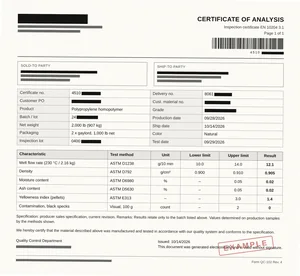 View example
See what one looks like and what to check: lot number, melt flow, density, test methods. How to read a COA
Buying one type? PP homopolymer and impact copolymer by melt flow · Metallocene PP · Carbon-filled PP
The short answer
Polypropylene is the usual pick when a part needs chemical resistance, low weight and a hinge that flexes for years, at a low resin cost. Choose the type first (homopolymer, random or impact copolymer), then the melt flow for your wall, then any filler. A common problem with PP is warp: it shrinks a lot and not evenly, so flat and long thin parts move after they leave the mold.
Grades we source
Tap a grade to add it to your quote request.
About Polypropylene (PP)
PP delivers excellent resistance to acids, bases, alcohols and detergents, a low density, and a unique living-hinge fatigue resistance, all at one of the lowest price points in plastics. It's widely available in food-contact and medical grades. It becomes brittle at low temperatures unless an impact copolymer is specified, and like most polyolefins it needs surface treatment for painting or bonding. For elastomers used to modify PP impact, see polyolefin elastomers (POE).
Common applications
- Rigid and thin-wall packaging
- Caps, closures and living hinges
- Housewares and consumer goods
- Automotive interior and battery trays
- Medical disposables
Typical properties
| Impact strength | Low-good (copolymer) |
|---|---|
| Heat (HDT at 0.45 MPa ISO 75 / 66 psi ASTM D648) | ~80–105°C / 176–221°F unfilled (about 45–60°C / 113–140°F at 1.82 MPa / 264 psi); higher when talc- or glass-filled |
| Clarity | Translucent; clarified random copolymer is near-transparent |
| Chemical resistance | Excellent to acids, bases, alcohols and detergents; limited to strong oxidizers, aromatic and chlorinated solvents |
| Relative cost | Low |
Property ranges are general guidance and vary by grade and supplier; a polymer chemist reviews the spec against the data sheet and COA.
Full data sheet values: Polypropylene density and properties
Which grade to ask for
Most PP requests fall into one of these grade types. Start from the part, not the data sheet.
| Grade type | Use it for | Watch out for |
|---|---|---|
| Homopolymer, mid melt flow | Stiff housewares, caps, living-hinge closures, parts that see dishwasher heat | Turns brittle near 0°C / 32°F. Not for parts that get dropped cold. |
| Impact copolymer | Totes, pails, battery cases, automotive interior, anything dropped or used in the cold | Lower stiffness and heat deflection than homopolymer. Whitens where it is bent or struck. |
| Clarified random copolymer | See-through storage boxes, housewares, medical disposables | Softer and lower melting than homopolymer. Clarity falls off as walls get thicker. |
| Talc-filled, 10% to 40% | Stiffer, flatter interior and appliance parts | Heavier part. Ask for ash content on the COA so you know the talc level is right. |
| Glass-filled | Brackets, pump and fan housings, structural parts | Shrinks about 5 times more across flow than along it in one 30% glass example, so warp. Ask whether the glass is chemically coupled. |
| Flame-retardant | Electrical and appliance housings | UL recognition is grade-specific and color-specific. Halogen-free and halogenated grades behave differently in the press. |
Typical starting points. Grades vary, so confirm on the data sheet for the exact grade.
Buying to a spec? See PP homopolymer for injection, PP impact copolymer and clear PP random copolymer.
Polypropylene resin suppliers: producers, distributors and where we fit
Polypropylene is made by a small number of producers and resold by distributors, traders and suppliers like us. Producers of widely used PP grades include LyondellBasell (Pro-fax and Moplen), ExxonMobil, Braskem, TotalEnergies, Formosa Plastics (Formolene), Pinnacle Polymers and Borouge International, which now includes Borealis. Large producers mostly sell on contract by the truckload or railcar and send smaller buyers to distributors.
| Who you buy from | Typical order | What to expect |
|---|---|---|
| Producer | Truckload, bulk truck or railcar, mostly on contract | The producer’s COA and compliance letters. In a shortage, contract customers are served first. |
| Distributor | A pallet of bags or one gaylord up to a truckload, varies by firm | Buys producer grades and resells them, often in a region. An authorized distributor has the producer’s support behind it. |
| Broker or trader | Often truckload or railcar lots | A broker never takes title; a trader does. Many also sell wide-spec, off-grade or surplus alongside prime, so check the paperwork. |
| ResinBridge | One gaylord to a railcar | A resin supplier that quotes polypropylene through supply partners. A polymer chemist reviews every request, the quote says whether material is prime, surplus or recycled, and every prime lot ships with a supplier COA. |
If you are looking for a polypropylene resin supplier for smaller lots, or a second source next to a producer contract, that is where we fit. See resin distributor vs. broker vs. trader for who takes title and who stands behind quality.
Commonly specified PP grades to quote or match
| Brand or grade | Producer | What it is |
|---|---|---|
| Pro-fax 6523 | LyondellBasell | PP homopolymer, melt flow 4.0 g/10 min. Part of the Pro-fax line. |
| ExxonMobil PP1024E4 | ExxonMobil | PP homopolymer, melt flow 13 g/10 min. ExxonMobil sells PP as ExxonMobil PP and Exceed PP. |
| Moplen | LyondellBasell | Homopolymer, random and impact copolymer PP |
| Formolene | Formosa Plastics | Homopolymer, impact copolymer and random copolymer PP |
| Braskem PP | Braskem | Sold by grade number, such as PP H521 |
| TotalEnergies PP | TotalEnergies | PP made at plants including La Porte, Texas, which TotalEnergies calls one of the largest polypropylene production facilities in North America |
| Pinnacle Polymers PP | Pinnacle Polymers | Homopolymer, impact copolymer and random copolymer PP |
| Daplen and Fibremod | Borealis, part of Borouge International | Mineral-filled and fiber-reinforced PP compounds |
Send any of these names, or a grade from another producer, and a polymer chemist quotes that grade or a matched alternative. Alternatives are subject to your approval. Naming a brand does not mean we have a partnership with its producer; the names belong to their owners. More names and equivalents: the Resin grade cross-reference and the plastic trade name decoder.
Grade finder: start from what you make
Pick your process, find the row for your product, and tap Request a Quote to add it to the form.
| Product | Grade family | Typical window | Put on the RFQ | Quote |
|---|---|---|---|---|
| Caps, flip-top closures and living hinges | Homopolymer, often nucleated | MFR about 10–35 g/10 min (230°C / 446°F, 2.16 kg); flex modulus about 1.4–2.0 GPa (about 200–290 kpsi), 1% secant by ASTM D790 | Nucleated or not (it changes shrink, cycle time and hinge feel), whether a slip agent is present (it changes removal torque), and the hinge cycle test your customer uses. PP homopolymer, injection › | |
| Pails, crates, totes and battery cases | Impact copolymer, medium to high impact | MFR about 5–30 g/10 min (230°C / 446°F, 2.16 kg); notched Izod about 2–10 ft-lb/in (about 110–530 J/m) by ASTM D256 at 23°C / 73°F, higher for pails than crates | Impact at the coldest temperature the part sees, and a flex modulus floor so floors and lids stay stiff. PP impact copolymer › | |
| Clear storage boxes and housewares | Clarified random copolymer | MFR about 10–35 g/10 min (230°C / 446°F, 2.16 kg); flex modulus about 0.9–1.2 GPa (about 130–174 kpsi), 1% secant | Clarified, haze by ASTM D1003 at a stated thickness, and antistatic if the box sits on a shelf. Clear PP random copolymer › | |
| Syringes, labware and medical disposables | Clarified random copolymer or homopolymer | MFR about 10–35 g/10 min (230°C / 446°F, 2.16 kg); type set by clarity and stiffness | The sterilization method (gamma or e-beam needs a radiation-resistant grade), any USP Class VI or ISO 10993 data your customer asks for, and the producer’s medical-use policy for the grade. FDA and medical grades › | |
| Deli containers, tubs and lids, including IML | Homopolymer or impact copolymer, high flow, nucleated | MFR about 35–100+ g/10 min (230°C / 446°F, 2.16 kg); for freezer tubs, a medium-impact copolymer with notched Izod about 1.5–2.5 ft-lb/in (about 80–130 J/m) at 23°C / 73°F | Nucleated and antistatic, and impact copolymer if the container is frozen or dropped. PP impact copolymer › | |
| Clear drink cups and clear thin-wall lids | Clarified random copolymer, high flow | MFR about 35–100 g/10 min (230°C / 446°F, 2.16 kg); lower stiffness than homopolymer | Haze at your wall thickness, low odor and taste, and the producer’s FDA letter. Clear PP random copolymer › | |
| Spunbond nonwovens (hygiene, medical, wipes) | Homopolymer, controlled rheology | MFR about 25–40 g/10 min (230°C / 446°F, 2.16 kg) | Controlled-rheology grade with a narrow molecular weight distribution, and a clean additive package for spinning. PP homo and copolymer › | |
| Meltblown filter media | Homopolymer, very high flow | MFR about 400–1,800 g/10 min, quoted at 230°C / 446°F, 2.16 kg. Above about 75 g/10 min, ASTM D1238 allows a half-size die (Procedure C), and those results do not convert simply to the standard die | Which MFR procedure the data sheet uses, whether the grade is reactor-made (often metallocene) or peroxide-visbroken, and whether it suits electret charging for filters. PP homo and copolymer › | |
| Carpet yarn (BCF) and staple fiber | Homopolymer fiber grade | MFR about 3–35 g/10 min (230°C / 446°F, 2.16 kg): about 3–25 for staple by denier, about 15–35 for BCF and CF | MFR spread lot to lot, and a UV package for outdoor or automotive fiber. PP homo and copolymer › | |
| Raffia, woven sacks, FIBC and strapping | Homopolymer tape grade | MFR about 2–4 g/10 min (230°C / 446°F, 2.16 kg) for tape and raffia; strapping grades about 0.6–3, with heavy-duty strapping near the low end | A UV package rated for the outdoor life of the sack, and whether you add calcium carbonate filler. PP fiber and nonwoven resin › | |
| BOPP film | Homopolymer for the core, random copolymer or terpolymer for sealant skins | Core MFR about 2–4 g/10 min (230°C / 446°F, 2.16 kg); skin layers about 5–8 | Core or skin layer, and the slip, antiblock and antistatic package. Film, bags and liners › | |
| Cast PP film | Homopolymer or random copolymer | MFR about 7–12 g/10 min (230°C / 446°F, 2.16 kg) | Random copolymer for lower seal temperature and clarity, and slip and antiblock levels. Film, bags and liners › | |
| Thermoformed cups, containers and trays from sheet | Homopolymer, nucleated or clarified, or random copolymer | MFR about 1.5–4 g/10 min (230°C / 446°F, 2.16 kg); flex modulus about 1.4–2.0 GPa for nucleated homopolymer | Nucleated or clarified, and the sheet thickness you form. PP homo and copolymer › | |
| Heavy industrial sheet, tanks and profiles | Homopolymer (often beta-nucleated) or impact copolymer | MFR about 0.3–2 g/10 min (230°C / 446°F, 2.16 kg) | Homopolymer for stiffness and chemical tanks, impact copolymer for cold use, plus a UV or heat stabilizer. PP homo and copolymer › | |
| PP-R plumbing and pressure pipe | Random copolymer pipe grade | MFR about 0.2–0.5 g/10 min (230°C / 446°F, 2.16 kg) | The pipe standard (for example ASTM F2389 in the U.S. or CSA B137.11 in Canada) and the NSF listings tied to the exact compound and color. Pipe and conduit › | |
| Base resin for talc, glass and color compounds | Homopolymer or impact copolymer, pellets or powder | MFR about 10–50 g/10 min (230°C / 446°F, 2.16 kg), higher for some long-glass and thin-wall compounds | Pellet or reactor powder, the stabilizer level, and whether the compound needs a maleated PP coupling agent. Compounders › | |
| Bumper fascia, interior trim and instrument panels | TPO or talc-filled impact copolymer compound | MFR about 15–35 g/10 min (230°C / 446°F, 2.16 kg); flex modulus about 0.9–2.5 GPa (about 130–360 kpsi), lowest for fascia TPO, highest for talc-filled trim and panels | The OEM material spec number, color, scratch resistance and low odor and fogging. Automotive › | |
| Washer tubs, appliance housings and brackets | Talc- or calcium carbonate-filled homopolymer, 20–40% | MFR about 4–20 g/10 min (230°C / 446°F, 2.16 kg); flex modulus about 2–4 GPa (about 290–580 kpsi), higher at 40% talc than at 20% or with calcium carbonate | Ash content on the COA, long-term heat aging, and UL 94 and RTI if the part sits near live electrical parts. Appliances › |
These windows are typical published ranges to start the conversation, so confirm against the data sheet for the grade you run and let a chemist check any alternative before you switch.
Processing notes
- Drying. Not needed for natural, unfilled PP. If surface moisture causes splay, follow the drying step on that grade’s data sheet. Filled and reinforced grades are moisture-sensitive; producer sheets dry them at about 80–82°C / 176–180°F for 2–3 hours. See the drying chart for other resins.
- Melt temperature. 200 to 260°C / 392 to 500°F for both homopolymer and copolymer. Run high-flow thin-wall grades toward the top of the range, and purge homopolymer if the barrel sits idle more than about 30 minutes.
- Mold temperature. 10 to 60°C / 50 to 140°F for homopolymer and 15 to 65°C / 59 to 149°F for copolymer. A warmer mold means more shrinkage in the mold and less after ejection.
- Shrinkage. Unfilled homopolymer 0.8–2.5%, copolymer 1.2–2.0%. With 20% talc about 1.10–1.50%, with 40% talc about 0.70–1.00%. One 30% glass grade is 0.24% along flow and 1.15% across. Measure parts at least 24 hours after molding, and 48 hours is better: one producer puts polyolefin parts at only about 90% of their total shrinkage by 48 hours.
- Regrind. 20–30% same-grade regrind is a common start, more in non-critical parts. Each pass uses up stabilizer and raises melt flow. Natural and light colors yellow first.
- Most common defect: warp. Uneven walls, gating and unbalanced cooling are the usual causes. Fix those before you switch to a talc-filled grade. See warped parts.
How polypropylene prices are set
Most polypropylene in North America sells on contract, and most contracts are built on propylene. Each month the polymer-grade propylene (PGP) contract settles between large buyers and sellers. Some contracts use a monthly average of spot PGP instead. PP contract prices then move up or down by about the same amount per pound, which the trade calls monomer pass-through. On top of that, producers nominate margin increases (or, less often, decreases) by letter, and those settle in full, in part or not at all depending on the market. Price reporting services such as S&P Global Energy (Platts, formerly S&P Global Commodity Insights), ICIS (which owns Chemical Data, or CDI) and OPIS report the PGP settlement and spot PGP, and they and consultants such as Resin Technology Inc. (RTi) track what moved in PP homopolymer and copolymer contracts. Spot railcars of prime, generic prime and wide-spec trade separately and move faster. The Plastics Exchange is one source that reports spot PP.
What moves the price: U.S. propylene comes from three places, steam crackers, refineries and propane dehydrogenation (PDH) plants. As crackers moved to ethane, they make far less propylene, so refinery runs and PDH plants matter more. An outage at a PDH unit, a propylene splitter or a large PP plant, a Gulf Coast hurricane or a hard freeze can tighten supply within weeks. New capacity, imports and weak demand push the other way. Filler, color and additives are priced on top of the base resin, so a talc-filled or black grade does not track the PP index one for one.
A warning about search results: many PP price per pound numbers online are recycled bale prices, old news articles or retail prices for craft pellets. None of them is the price of prime pellets for a production line.
We do not post prices. Every quote is for a specific grade, quantity, package and ship-to city. See how resin is priced for the mechanics and the resin market notes for which way PP is moving this month.
What order size does to the price
| How you buy | Typical size | Why the price per pound differs |
|---|---|---|
| Hopper railcar | About 180,000–210,000 lb | Closest to contract and index pricing. No packaging and the lowest freight per pound, but you need a rail siding and silos, or a transload terminal. |
| Bulk truck (pneumatic hopper) | About 40,000–50,000 lb | No packaging cost. Often reloaded from a railcar at a terminal, which adds a handling charge over rail. You need a silo. |
| Boxed truckload (gaylords) | About 40,000–45,000 lb of boxed PP, roughly 30 or more gaylords at about 1,200–1,450 lb each (boxes are double-stacked to reach full weight) | Adds the cost of boxes, liners, pallets and packaging. Freight per pound is still low because the truck is full. |
| LTL or partial truckload gaylords | 2 to about 18 gaylords | Freight per pound runs several times a full truck. Terminal handling, liftgate and fuel surcharges add up. |
| Single gaylord | About 1,000–1,600 lb | The highest freight per pound for boxed resin. The seller’s fixed cost of each order (paperwork, COA, credit, handling) is spread over one box. |
| Small boxes or bags | 55 lb (25 kg) bags or boxes | The highest price per pound. Packaging and handling are a large share of the cost. Mostly used for samples and lab trials. |
Freight to your dock, FOB versus delivered terms, imported versus domestic resin and prime versus wide-spec can move the price as much as order size, so send your ship-to city with every request.
Ways to lower the cost: buy a truckload instead of gaylords, tell us imported resin is OK, or ask about surplus lots and recycled grades if your part allows. See how resin is priced.
Packaging and lead times
| Package | Typical net weight | Notes |
|---|---|---|
| Bag | 55 lb (25 kg) | Often about 40–55 bags per pallet. Common for filled, colored and specialty PP and for samples. |
| Gaylord (box with liner) | About 1,000–1,600 lb | Unfilled PP pellets have a low bulk density, about 30–36 lb/ft³, so a PP gaylord usually nets in the lower to middle part of that range. Filled grades weigh more per box. Check net weight on the quote. |
| Bulk bag | About 1,000–2,200 lb | Needs a bag unloader or discharge frame. Less floor space and less cardboard than gaylords. |
| Bulk truck | About 40,000–50,000 lb | Unloaded by air into your silo. Check seal numbers against the bill of lading. |
| Hopper railcar | About 180,000–210,000 lb | Needs a rail siding or a transload. Demurrage starts if the car sits past the railroad’s free time. |
Lead time is confirmed with your quote, and we do not promise a ship date until the source has confirmed it. How long it takes depends mostly on where the resin is. Material that is already packaged and in a supplier’s inventory usually ships first. A grade, color or filled compound that has to be made or packaged on a producer’s or compounder’s schedule waits for the next run, which can take weeks. Railcars add rail transit time, which varies by lane.
When producers declare force majeure or put grades on allocation, contract customers are served first and spot supply dries up, so lead times stretch for everyone. Tell us the date you need resin on your floor and how much you have on hand, and we will tell you what is realistic. See what to do under allocation or force majeure and gaylord vs. LTL vs. truckload.
What to put on the purchase order
- Type and melt flow, with the test condition. Homopolymer, random or impact copolymer, and MFR at 230°C / 446°F and 2.16 kg (ASTM D1238 or ISO 1133). A polyethylene melt index at 190°C is not comparable.
- Filler type and level. Talc, calcium carbonate or glass, the percentage, and an ash value on the COA to confirm it.
- Additive package. Nucleated or clarified, antistatic, UV-stabilized, and for glass-filled grades, chemically coupled or not.
- Color. Natural, black or a color match. See masterbatch vs. precolored resin.
- Food contact. Ask for the producer's FDA letter for the exact grade. For PP these letters usually cite 21 CFR 177.1520 and state conditions of use. Colorants and additives you add need their own documents.
- Flame rating. The UL 94 rating, the thickness it applies at and the color. Check the grade's listing on UL Product iQ before you approve a substitute.
- Packaging and COA. PP pellets run about 30–36 lb/ft³, so a standard gaylord of about 40 ft³ holds about 1,200–1,450 lb. Check net weight on the quote. Ask for melt flow (and ash, if filled) on every lot COA.
Prime, wide-spec, reprocessed or recycled
| Material | What it is | When it makes sense | What to ask for |
|---|---|---|---|
| Prime | The producer’s first-quality resin, in spec and sold under its grade name with a lot COA. | Any part with a spec, a customer or OEM approval, a UL listing or food contact. | The grade name, a lot COA and the producer’s FDA letter if food is involved. |
| Wide-spec | Made by the producer but outside the published window on one or more properties, often MFR or color. Sold without the grade name. | Non-critical molded parts, sheet and compounding feed that tolerate some variation. | Which property is off and by how much, the MFR measured on each lot, and whether it is homopolymer or copolymer. |
| Off-grade or near-prime | Transition material made while a reactor changes grades, or lots with a defect. Near-prime sits close to spec. | Price-driven parts where you can test every lot and blend it in. | MFR range, type (homo, random or impact), odor and a sample before you buy the lot. |
| Reprocessed (repro) | Industrial scrap that has been ground, melted, filtered and pelletized again. | Black or dark parts, pallets, and products that allow a set share of repro. | The source stream, MFR range lot to lot, ash if filled scrap may be mixed in, screen mesh and color. |
| PCR | Post-consumer recycled: caps, tubs and other used PP packaging that has been sorted, washed and pelletized. | When your customer or a state law requires recycled content. | MFR window, ash, odor and color. For food contact, the FDA letter of no objection (NOL) for the recycler’s process: FDA issues it for a recycling process and stated conditions of use, not for each lot, so confirm the lot came from that process. See recycled resin. |
| PIR | Post-industrial recycled: clean scrap from manufacturing, such as nonwoven or film trim, that never reached a consumer. | Recycled content with more consistency than PCR. | The source process, and whether your customer counts PIR toward its recycled-content target. See prime vs. off-grade. |
Checking the COA when the lot arrives
- Lot number. The lot on the COA matches the label on every gaylord or bag, and the seal numbers match the bill of lading for bulk.
- MFR by the right condition. MFR at 230°C / 446°F and 2.16 kg is inside your window. A PE melt index at 190°C / 374°F is not comparable, and a meltblown grade may be tested with the half-size die of ASTM D1238 Procedure C, which does not compare directly with the standard die.
- Ash for filled grades. Ash content (ASTM D5630 or ISO 3451-1) confirms the talc, calcium carbonate or glass level. A few points off changes stiffness, shrink and part weight.
- Impact if reported. If the COA lists notched Izod, check it at the same temperature and method as your spec. ASTM D256 in J/m and ISO 180 in kJ/m² do not convert into each other.
- Type and additive package. The grade name matches your PO, and nucleated, clarified, antistatic or UV status has not changed. A switch from nucleated to not nucleated moves shrinkage and cycle time.
- Color and odor. Check pellet color or yellowness if the COA reports it, and smell an open bag for clarified, food and recycled grades.
- Pellets and packaging. Liners intact, no water or dust, and no fines or streamers. Filled grades that sat damp may need drying.
- Keep a retain. Seal a small sample of each lot so you can test it later. See the incoming inspection checklist and what a COA is.
Adding a second source without stopping the line
- Write down what you run now. The grade, its data sheet, three to six recent COAs with actual lot values, your process settings and every approval tied to the grade (FDA letter, UL listing, OEM spec, customer approval).
- Match on paper first. A polymer chemist compares type, MFR at 230°C / 446°F and 2.16 kg, reactor or controlled rheology, nucleation, impact and modulus, filler and documents, and tells you what differs.
- Sample, then a production trial. Check a sample in the lab, then run one gaylord on a normal shift next to your current grade. Measure shrink and warp at least 24 hours after molding, plus cycle time and the tests your customer uses.
- Get approvals before volume. UL-listed, OEM-spec and customer-approved parts need requalification. Start that paperwork early, since it usually takes longer than the trial.
- Keep the second source active. Buy a small regular volume and trend its COAs, so it is ready if your main grade goes on allocation. See how to qualify a second resin source.
Want a chemist to compare a second source with what you run now? Send the grade and recent COAs through the quote form or an RFQ package.
When to consider something else
- If you need gloss, paintability or tighter tolerances in a rigid housing, look at ABS: PP vs. ABS.
- If the part has to stay tough well below freezing and does not see heat, look at HDPE: PP vs. HDPE.
- If glass-filled PP creeps or softens at your service temperature, look at glass-filled PP vs. nylon.
- If you need a soft, rubbery feel or a grip overmold, look at TPE and TPV.
- If the part must be truly clear and tough, see the best plastic for clear parts.
Looking at off-grade PP for non-critical parts? See wide-spec and off-grade polypropylene. For gray or black recycled PP pellets and regrind, see mixed-color polypropylene.
Named grades with their own page
Typical data, close alternatives to qualify and buying notes for common named grades in this family: ExxonMobil PP1024E4 · ExxonMobil PP7033E2 · Formolene 4100N · Pro-fax 6331 · Pro-fax 6523 · Pro-fax PD702 · Pro-fax SE012 · Pro-fax SR257M · Pro-fax SV258. Running a grade that is not listed? Send it and a polymer chemist will check it.
Common questions
Is polypropylene food safe?
Many PP grades are made for food contact, but compliance belongs to the grade, not the family. Ask for the producer's FDA letter for the exact grade, and check that any colorant or additive you add is covered too. A polymer chemist can confirm which documents come with a grade before you order.
Does polypropylene need to be dried?
Usually not. Natural, unfilled PP takes up only surface moisture. If parts show splay or the resin picked up condensation, follow the drying step on that grade’s data sheet. Filled and glass-reinforced grades are moisture-sensitive; producer sheets dry them at about 80–82°C / 176–180°F for 2–3 hours.
Can polypropylene go in the dishwasher and microwave?
PP homopolymer melts at about 160–165°C / 320–329°F, well above HDPE, which is why it is the common choice for dishwasher-safe and microwavable housewares. Whether a given part qualifies depends on the grade, the wall and the conditions of use stated in the producer's food-contact letter.
Why do my polypropylene parts warp?
PP shrinks 0.8–2.5% unfilled, and more in one direction than the other, so any uneven wall or cooling turns into bow or twist. Glass fill makes it worse because fibers restrain shrinkage along flow but not across it. Talc-filled grades shrink less and more evenly.
What is the price of polypropylene per pound?
We do not post a price because there is no single one. PP contract prices follow the monthly propylene (PGP) settlement plus any margin changes, and your price also depends on the type, filler, quantity, packaging and freight to your dock. Many PP price per pound search results are recycled bale or retail craft-pellet prices. See the resin market notes for direction, and send your grade, quantity and ship-to city for a firm quote.
What is the minimum order for polypropylene?
One gaylord, about 1,000 to 1,600 lb. There is no truckload minimum. To qualify a production grade, ask about a sample of about 50 lb, available upon credit approval. If you need a few pounds for crafts or weighting, a retail seller is a better fit.
How long does polypropylene take to arrive?
It depends on whether the grade is already packaged in inventory, needs a slot in a producer’s or compounder’s schedule, or is on allocation. Lead time is confirmed with your quote, and we aim to send quotes within one to three business days.
What is the difference between FOB and delivered pricing?
An FOB price with a named point, such as a shipping point, stops at that point and freight is extra. A delivered price includes freight to your dock. Who carries the risk in transit depends on the terms written on the quote, so read them, and compare quotes on delivered cost per pound.
What is the difference between reactor and controlled-rheology PP?
A reactor grade gets its MFR straight from polymerization and has a broader molecular weight distribution, which gives more stiffness and melt strength for sheet and thermoforming. A controlled-rheology (vis-broken) grade starts as a lower-MFR resin and is broken down with peroxide in the extruder, which raises MFR and narrows the distribution. That gives more even filling, less orientation and warp, and better spinning for fiber, at a little less stiffness. Swapping one for the other at the same MFR can change shrink, warp and cycle time, so trial it first.
Are you a polypropylene distributor or a producer?
Neither. ResinBridge is a resin supplier, not a producer or an authorized distributor for any producer. We quote polypropylene through our supply partners, from one gaylord (about 1,000 to 1,600 lb) to a railcar, a polymer chemist reviews every request, and every prime lot ships with a supplier COA. See resin distributor vs. broker vs. trader.
Related pages (32)
Talk to a polymer chemist
Have a grade on a print, a bag label, or just a part you need to make? Send what you have.
- Send the grade, a callout or a photo of the bag label.
- We check it, and suggest a matched alternative if it is hard to get.
- We aim to quote within one to three business days, from one gaylord to a railcar.
Tell us the Polypropylene grade you run now
A polymer chemist reviews every request, then matches your grade or finds a matched alternative and prices it.
What to send for an accurate quote
- The grade name, from any supplier, or a data sheet
- Color (natural, black or a custom match)
- Fill type and percentage, if any
- Melt flow, if you know it
- Quantity for this order and what you use in a year
- Ship-to ZIP or postal code