The short answer
Glass-filled nylon is tougher, handles more heat (PA66) and survives hot water and glycol with the right stabilizers. Glass-filled PBT absorbs almost no moisture, so its dimensions and stiffness stay steady, and it molds fast with good electrical properties. Pick nylon for heat, toughness and coolant contact; pick PBT for dimensional stability and electrical parts.
Glass-filled nylon and glass-filled PBT compete for many of the same parts: connectors, housings, brackets and sensor bodies. The deciding factors are usually moisture, heat and chemical contact.
Side by side: 30% glass-filled grades
| Property | PA66 GF30 | PA6 GF30 | PBT GF30 |
|---|---|---|---|
| Density | ~1.37–1.39 g/cm³ | ~1.35–1.37 g/cm³ | ~1.52–1.54 g/cm³ |
| Tensile strength, dry as molded | ~170–200 MPa | ~150–185 MPa | ~120–140 MPa |
| Flexural modulus, dry as molded | ~8.5–10 GPa | ~8–9.5 GPa | ~8–9.5 GPa |
| Stiffness after conditioning (50% RH) | Drops noticeably | Drops noticeably | Barely changes |
| Heat deflection, 1.8 MPa | ~235–250°C | ~200–210°C | ~200–210°C |
| Water absorption, 24 h | ~0.7–1.0% | ~0.9–1.2% | ~0.06–0.08% |
| Impact strength | Good, rises when conditioned | Good, rises when conditioned | Moderate |
| Hot water, glycol, alkalis | Good with hydrolysis-stabilized grades | Fair | Poor |
| Fuels, oils, greases | Good | Good | Good |
| Drying | ~80°C | ~80°C | ~120°C |
Typical values for general-purpose grades. Individual grades vary; check the data sheet. Processing figures match our processing chart and drying chart.
Moisture is the biggest difference
Nylon keeps absorbing water from the air after molding until it reaches equilibrium, and as it does, it grows slightly, loses stiffness and gains toughness. PBT absorbs so little that a part measured on Monday measures the same a month later. If a nylon part drifts out of tolerance or softens in humid conditions, PBT is often the fix. See nylon parts swelling from moisture.
Heat and chemicals
Glass-filled PA66 runs about 40 to 50°C hotter than PBT under load, and hydrolysis-stabilized nylon grades handle hot water and engine coolant that would weaken PBT over time. PBT holds up well to fuels, oils and many solvents but should be avoided in hot water, steam and strong alkalis.
Choose glass-filled nylon when
- The part runs hot or carries load at temperature (PA66)
- It touches hot water, glycol or coolant
- Toughness and impact matter
- The approval already specifies nylon
Choose glass-filled PBT when
- Tight tolerances must hold in humid conditions
- It is an electrical part that needs stable properties
- Fast cycles matter
- Moisture swelling has been a problem with nylon
At higher glass levels
At 50 to 55% glass, both become very stiff metal-replacement materials. A highly glass-filled PBT or PBT/PET blend offers stiffness close to highly filled nylon with far less moisture uptake, which suits brackets and structural parts that must hold their dimensions.
Common questions
Is glass-filled PBT stronger than glass-filled nylon?
Dry as molded, glass-filled nylon is noticeably stronger, roughly 30 to 40% higher in tensile strength, especially PA66. But nylon loses stiffness as it absorbs moisture, while PBT barely changes, so in humid service the gap narrows.
Which absorbs less water, nylon or PBT?
PBT, by a wide margin. Glass-filled PBT takes up well under 0.1% water in 24 hours; glass-filled nylon takes up about ten times that and keeps absorbing until it reaches equilibrium.
Can glass-filled PBT replace glass-filled nylon?
In many electrical and dimension-critical parts, yes. It is not a good swap for parts in hot water, glycol or strong alkalis, or where high impact strength is needed. Check heat, chemicals and approvals first.
Which is better for electrical connectors?
Both are widely used. PBT is chosen for dimensional stability, fast molding and good electrical properties; PA66 for higher heat and toughness. FR grades of both are common.
Do both need drying?
Yes. Both are hydrolysis-sensitive, so wet resin cuts the polymer chains even when the part looks fine. PBT is typically dried at about 120°C and nylon at about 80°C. See the drying chart.
Tell us the grade you run now
A polymer chemist reviews every request, then matches your grade or finds a qualified equivalent and prices it.
What to send for an accurate quote
- The grade name, from any supplier, or a data sheet
- Color (natural, black or a custom match)
- Fill type and percentage, if any
- Melt flow, if you know it
- Quantity for this order and what you use in a year
- Ship-to city and state or province
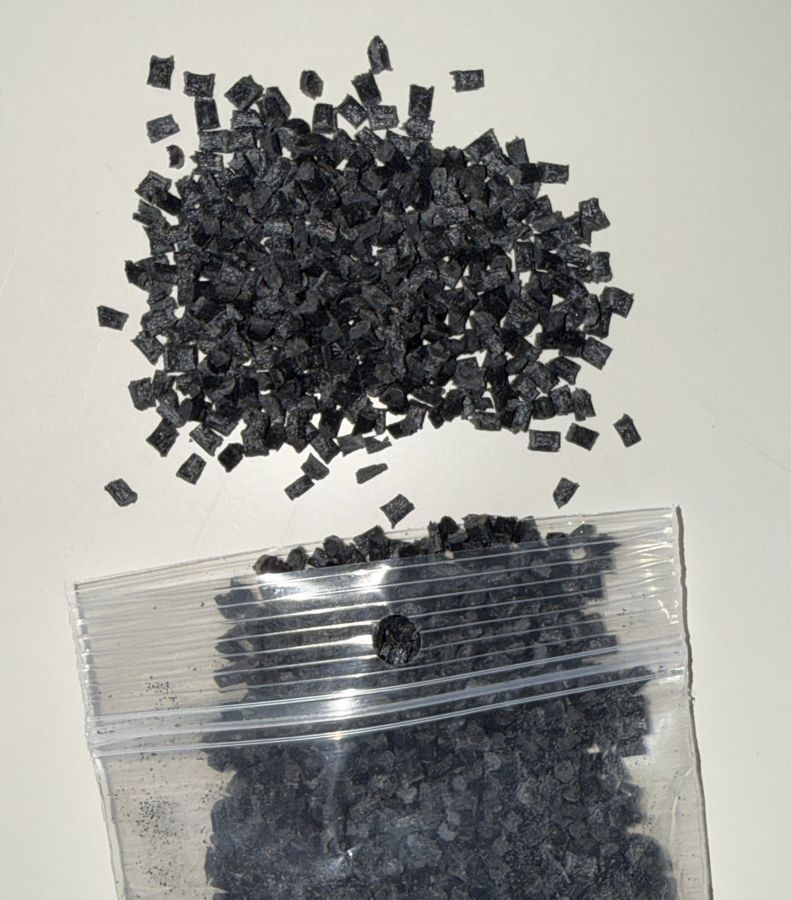 Surplus lot · Available nowPBT/PET, 55% glass-filled, black120,000 lb of prime material at 65% off typical price. Stiffness close to highly filled nylon with far less moisture uptake.See the lot