The short answer
The easiest fix is the same PA66 grade from a second source, because the base polymer stays the same, so the part design and tool usually do not change. If PA66 itself is tight, PA6 at the same glass level replaces it in most parts that do not run hot. For hot parts, look at PPA; for electrical and dimension-critical parts, glass-filled PBT; for gears and fuel contact, POK or acetal.
PA66 is one of the most widely used engineering resins, and it is also one of the first to tighten when supply is disrupted. Buyers usually find out when a lead time doubles or an allocation letter arrives. This page lays out the alternatives, which parts each one suits, and how to switch without a production problem.
Why PA66 gets tight
PA66 is made from two building blocks, and one of them depends on an intermediate that only a few companies produce worldwide. When one of those plants has an outage, a hurricane or a force majeure, there is little spare capacity to cover it, so PA66 tightens across the whole market at once. PA6 is made from caprolactam, which many producers make, so it rarely tightens at the same time.
PA66 alternatives compared
| Alternative | Works best for | Watch for |
|---|---|---|
| PA66 from another source | Any PA66 part | Stabilizer package, viscosity, color and approvals must match; fastest route because the polymer is the same |
| PA6, same glass level | Parts at or near room temperature; housings, brackets, power-tool parts | About 30–40°C lower heat deflection with glass; slightly higher moisture uptake; easier processing and better surface |
| PA6/66 copolymer | Flexible or tough parts, film, some extrusion | Lower melting point than either; judge on the data sheet, not as a midpoint |
| PPA (polyphthalamide) | Hot under-hood, electrical and structural parts | Melt runs about 320–345°C and molds typically need 135°C or more (some grades run near 90°C); costs more; absorbs less water than PA66 |
| Glass-filled PBT or PET | Connectors, sensors, electrical housings, dimension-critical parts | Far lower moisture uptake; weaker in hot water and glycol, so not for coolant-contact parts |
| Polyketone (POK) | Gears, fuel and chemical contact, parts that need impact strength | Low moisture uptake and good chemical resistance; supply is mostly imported |
| Acetal (POM) | Gears, bushings, wear parts, snap fits at moderate temperature | Low friction and very stable dimensions; lower heat ceiling than PA66 |
| Post-industrial PA66 | Parts where the spec allows recycled content | Lot-to-lot consistency varies; confirm the COA on every lot |
General guidance. The right choice depends on the grade, glass level, stabilizers and approvals on your part.
Best alternative by application
| Application | First choice | Why |
|---|---|---|
| Radiator end tanks, coolant and glycol contact | PA66 from another source (hydrolysis-stabilized) or PPA | PBT and PET lose strength in hot glycol; PA6 runs closer to its heat limit |
| Electrical connectors and terminal blocks | PA66 from another source, PBT GF or PA6 FR | Match the flame rating and CTI on the approval |
| Brackets, housings and covers at moderate temperature | PA6 GF at the same glass level | Check dimensions on first parts |
| Gears and bushings | PA6, POM or POK | Lubricated grades help wear |
| Hot under-hood structural parts | PA66 from another source or PPA | PA6 is usually too close to its limit |
How to switch without a production problem
- Start with the same grade from another source. Ask for a matched PA66 grade with the same glass level, stabilizer package and color before changing materials.
- Check heat and chemistry. Compare heat deflection against the real service temperature, including peaks, and check contact with glycol, hot water, fuels or cleaners.
- Compare conditioned properties. Nylon parts live at about 50% relative humidity, not dry as molded, so compare stiffness and impact in that state.
- Check the tool. Shrinkage changes with the polymer and the glass level; measure first parts on tight-tolerance features.
- Reset the process. Melt and mold temperatures differ; do not carry over the old settings. See the processing chart and drying chart.
- Handle approvals early. Tell your customer before the trial if the part carries an automotive, UL or food-contact approval.
- Keep the backup qualified. Once a second source or alternate material is approved, keep it on file so the next shortage is a phone call, not a scramble.
How we help
Send the PA66 grade you run now, or the data sheet, and a polymer chemist will look for a matched PA66 from another source where possible and suggest an alternate material if needed, with a COA on every lot, tested to ASTM or ISO methods. We ship to the U.S. and Canada from 22 warehouse locations, from one gaylord to a railcar. We aim to send your quote within one to three business days.
Common questions
What is the closest replacement for PA66?
The same PA66 grade from another qualified source is the closest replacement, because the base polymer stays the same, so the part design and tool usually do not change. If PA66 itself is hard to get, PA6 at the same glass level is the most common substitute for parts that do not run hot.
Can PA6 replace PA66 GF30?
Often. PA6 GF30 is close in strength and stiffness but its heat deflection is about 30 to 40°C lower, and it picks up a little more moisture. Check the real service temperature, measure first parts and requalify if your customer requires it.
When is PPA a better choice than PA66?
When the part needs more heat resistance, stiffness or dimensional stability than PA66 gives, such as hot under-hood parts or parts that see reflow-level heat. PPA runs hotter and usually costs more, so it is an upgrade rather than a like-for-like swap.
Why does PA66 supply get tight?
PA66 depends on a key intermediate that only a few companies make. When one of those plants has an outage, a hurricane or a force majeure, PA66 can tighten across the whole market at once. PA6 is made from a more widely available monomer.
Does switching from PA66 need a new approval?
Usually, if the material changes. Automotive, electrical and food-contact approvals are tied to a specific grade. The identical grade bought through another distributor may only need a first-article check. An equivalent PA66 from a different producer usually needs customer notification and often a PPAP or UL review. A different material normally needs full requalification.
Tell us the PA66 grade you run now
A polymer chemist reviews every request, then matches your grade or finds a qualified equivalent and prices it.
What to send for an accurate quote
- The grade name, from any supplier, or a data sheet
- Color (natural, black or a custom match)
- Fill type and percentage, if any
- Melt flow, if you know it
- Quantity for this order and what you use in a year
- Ship-to city and state or province
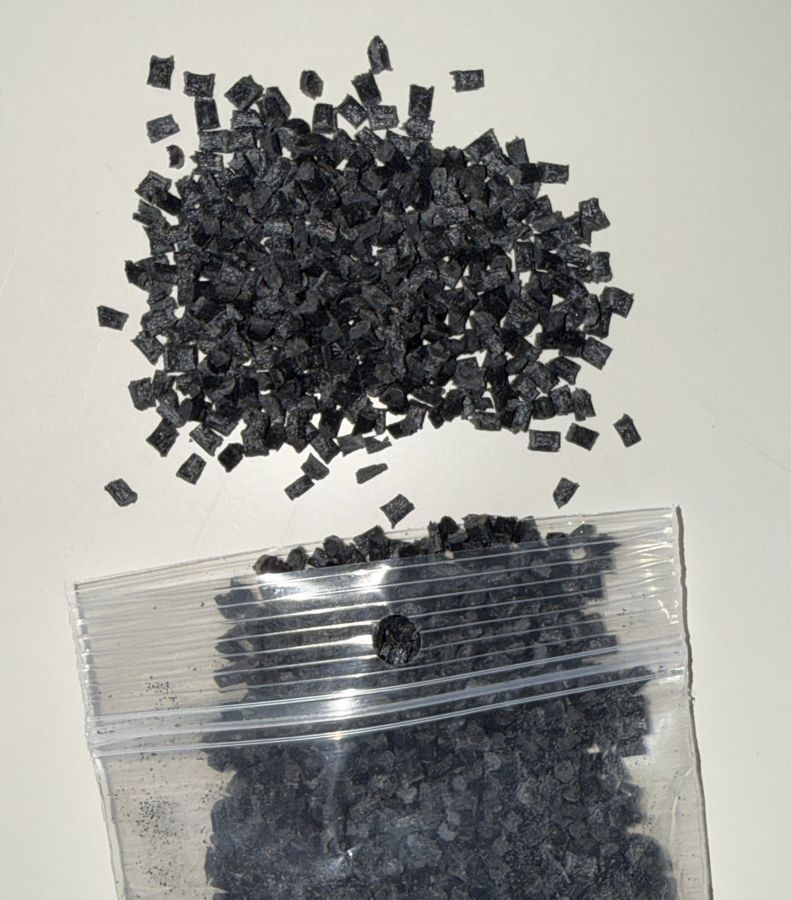 Surplus lot · Available nowPBT/PET, 55% glass-filled, black120,000 lb of prime material at 65% off typical price. A low-moisture option for brackets and housings while PA66 is tight.See the lot