The short answer
Nylon 66 melts about 40°C higher, is a little stiffer and holds its properties better when hot, which is why it dominates under-hood and electrical parts. Nylon 6 is easier to process, tougher once it has picked up moisture, gives a better surface with glass fill, and usually costs less with broader supply. At room temperature, for many parts, either one will do the job.
Nylon 6 and nylon 66 are the two most widely used polyamides, and they are close cousins. Most buyers run one or the other for years without a reason to question it, until a shortage, a price change or a new part forces the question. This page covers what actually differs, where it matters, and what to check before switching.
Where the names come from
The numbers count carbon atoms in the building blocks. Nylon 6 is made from a single monomer, caprolactam, which has six carbons; the ring opens and links into a chain. Nylon 66 is made from two monomers, hexamethylenediamine and adipic acid, each with six carbons, joined by condensation.
That difference in structure is the root of almost everything else. The PA66 chain is more regular, so its hydrogen bonds line up more neatly, it crystallizes faster and further, and it needs more heat to melt. PA6 is a little less ordered, which makes it melt lower, absorb water slightly faster and stay tougher.
Side by side: unfilled grades
| Property | Nylon 6 (PA6) | Nylon 66 (PA66) |
|---|---|---|
| Melting point | ~220°C (428°F) | ~260–265°C (500–509°F) |
| Density | 1.13 g/cm³ | 1.14 g/cm³ |
| Tensile strength, dry as molded | ~70–85 MPa (10,000–12,300 psi) | ~75–90 MPa (10,900–13,000 psi) |
| Flexural modulus, dry as molded | ~2.4–2.9 GPa | ~2.6–3.0 GPa |
| Stiffness after conditioning (50% RH) | Falls to roughly a third of the dry value | Falls to roughly 40 to 50% of the dry value |
| Notched impact | Higher, especially once conditioned | Lower, especially dry |
| Heat deflection, 1.8 MPa | ~55–65°C | ~70–90°C |
| Moisture at 23°C / 50% RH | ~2.7–3.2% | ~2.5–2.8% |
| Moisture, saturated in water | ~9–10% | ~8–8.5% |
| Mold shrinkage, unfilled | ~0.8–1.5% | ~1.0–1.8% |
| Melt temperature | 250–280°C (482–536°F) | 275–305°C (527–581°F) |
| Mold temperature | 40–100°C (104–212°F) | 60–100°C (140–212°F) |
| Crystallization speed | Slower | Faster; shorter cycles, more flash risk |
| Surface finish and dyeing | Glossier; takes color more deeply | Good |
| Relative cost and supply | Usually lower; broad supply | Usually higher; feedstock from few producers |
Side by side: 30% glass-filled grades
Most structural nylon is glass-filled. Glass raises strength and stiffness for both, and widens the heat gap.
| Property | Nylon 6 (PA6) | Nylon 66 (PA66) |
|---|---|---|
| Density | ~1.35–1.37 g/cm³ | ~1.37–1.39 g/cm³ |
| Tensile strength, dry as molded | ~150–185 MPa | ~170–200 MPa |
| Flexural modulus, dry as molded | ~8–9.5 GPa | ~8.5–10 GPa |
| Heat deflection, 1.8 MPa | ~200–210°C | ~235–250°C |
| Mold shrinkage, along / across flow | ~0.3% / 0.75% | ~0.5% / 1.1% |
| Surface appearance | Fewer exposed fibers at normal mold temperatures | Needs a hotter mold to hide glass |
Typical values for general-purpose grades, dry as molded unless noted. Individual grades vary with molecular weight, fill, impact modifier and stabilizers; check the data sheet for the grade you run. Processing figures match our processing parameters chart and drying chart.
Heat resistance
If a part runs hot, the choice usually makes itself. PA66’s higher melting point carries through to glass-filled heat deflection about 30 to 40°C above PA6, better creep resistance under load at temperature, and more margin near wave or hand soldering, hot fluids and engine-bay air. (Lead-free SMT reflow is beyond both; it generally needs PA46, PPA or LCP.) Heat-stabilized grades of either polymer are needed for long-term hot air aging; the stabilizer package often matters as much as the base polymer, so match it, not just the PA number.
Moisture absorption
Every nylon absorbs water from the air after molding, and it changes the part. Stiffness and strength drop, impact strength rises and the part grows slightly. PA6 absorbs a bit more and gets there a bit faster. Two practical rules:
- Design and test in the conditioned state, not dry as molded. Dry parts straight off the press are the stiffest and most brittle they will ever be.
- Dry the pellets before molding. Both are hydrolysis-sensitive, so wet resin cuts the polymer chains even when the part looks perfect. See nylon parts swelling or changing size and the drying chart.
Processing differences
- Temperature window. PA66 runs about 25°C hotter at the barrel. Running PA6 at PA66 settings degrades it; running PA66 at PA6 settings leaves unmelted pellets.
- Flash. PA66 has a sharp melting point and very low melt viscosity, so it finds parting-line gaps that PA6 would not. Tools built for PA6 sometimes flash on PA66.
- Cycle time. PA66 crystallizes faster and can often eject sooner.
- Surface finish. Glass-filled PA6 hides fibers more easily at normal mold temperatures. Glass-filled PA66 usually needs a hotter mold for the same look.
- Shrinkage. Unfilled PA66 usually shrinks a little more than PA6. With glass, both become strongly directional, so gate location drives final size.
Swapping one for the other
Switching between PA6 and PA66 is one of the most common second-source requests we see, usually because one of them is short or has gone up in price. It can work well, but it is a material change, not a grade change. Before switching, check:
- Service temperature. Compare heat deflection and continuous-use ratings against what the part really sees, including short peaks.
- Dimensions. Measure first parts. Shrinkage differs, especially unfilled; a tight-tolerance part may need a process change or a tool tweak.
- Conditioned properties. Compare stiffness and impact at 50% RH, since that is how the part lives.
- Process settings. Reset barrel and mold temperatures; do not carry the old sheet over.
- Approvals. Automotive, electrical (UL) and food-contact approvals are tied to a specific grade. A switch may need a new approval or a customer sign-off.
A PA6/66 copolymer is a third option for some applications. It is usually more flexible and tougher, with lower crystallinity and a lower melting point that depends on the ratio. Judge it against your data sheet, not as a midpoint between the two.
Choose nylon 6 when
- The part runs at or near room temperature
- Toughness and impact matter more than peak stiffness
- Surface finish on glass-filled parts matters
- You want broader supply and usually lower cost
- The part is painted, dyed or needs deep color
Choose nylon 66 when
- The part runs hot: under the hood, near motors, in hot fluids
- You need stiffness and creep resistance under load at temperature
- Electrical parts see high heat or wave soldering
- Faster cycles are worth a hotter process
- The application or approval already specifies PA66
Typical uses
| Application | Common choice | Why |
|---|---|---|
| Radiator end tanks, engine covers, air intake parts | PA66 GF30–35 | Heat and glycol resistance |
| Connectors, terminal blocks, breaker housings | PA66, often FR | Heat margin for electrical loads and wave soldering |
| Power-tool housings | PA6 GF, impact-modified | Toughness and surface finish |
| Gears, bushings, wear strips | Either, often lubricated | PA66 for warm, loaded gears; PA6 for impact and quiet running |
| Cable ties | PA66 | Stiffness and fast cycles |
| Furniture parts, chair bases, consumer goods | PA6 GF | Cost, surface and toughness |
| Film and extruded profiles | PA6 | Easier to extrude; common in barrier packaging film |
In carpet, fabric and rope
Many people searching this question are comparing carpets or fabrics. In fiber, nylon 66 is generally harder wearing and more resilient, holding its pile and resisting crushing and stains a little better. Nylon 6 dyes more deeply and is easier to recycle back into fiber. In practice the fiber treatment and construction matter as much as the polymer. ResinBridge supplies molding and extrusion resins, not fiber, but the chemistry behind the difference is the same.
Cost and supply
PA6 is made by many producers around the world, and caprolactam is widely available. PA66 depends on a key intermediate that only a few companies make, so when one of those plants goes down, PA66 can tighten quickly across the whole market. That is why buyers who run PA66 often want a qualified PA6 or alternate PA66 source on file before they need it. See how to set up a second source.
Grades we source
We source both PA6 and PA66 for buyers in the U.S. and Canada, from one gaylord up to truckload and railcar quantities, with a COA on every lot, tested to ASTM or ISO methods:
- Unfilled, general purpose
- Glass-filled, 13 to 50% (see glass-filled nylon)
- Impact-modified and toughened
- Heat-stabilized
- Flame-retardant
- Mineral and mineral-glass filled
- Carbon-filled (see carbon-filled nylon)
Common questions
Is nylon 66 stronger than nylon 6?
Slightly, and mainly when hot. Dry as molded, PA66 is a little stiffer and stronger than PA6, and it keeps more of that stiffness at elevated temperature because it melts about 40°C higher. At room temperature the gap is small, and once both have absorbed moisture PA6 is usually the tougher of the two.
What is the melting point of nylon 6 and nylon 66?
Nylon 6 melts at about 220°C (428°F). Nylon 66 melts at about 260 to 265°C (500 to 509°F). That 40°C difference is the main reason PA66 is chosen for hotter parts.
Which absorbs more water, nylon 6 or nylon 66?
Nylon 6 absorbs a little more and absorbs it a little faster. At 23°C and 50% relative humidity both settle at roughly 2.5 to 3% moisture, and fully saturated in water PA6 reaches about 9 to 10% against about 8% for PA66. Glass fill lowers both in proportion to the glass content.
Can I replace nylon 66 with nylon 6?
Often, but not automatically. PA6 can replace PA66 where the part never sees temperatures near PA6’s lower limits and the tool can absorb a small shrinkage change. Check heat deflection at the real service temperature, check dimensions on first parts, and requalify the part if your customer requires it. A polymer chemist can tell you whether a PA6 grade is a realistic swap for the PA66 you run.
Which is cheaper, nylon 6 or nylon 66?
Nylon 6 has usually been the lower-cost option, and its supply is broader. Nylon 66 depends on a feedstock made by only a few producers worldwide, so its availability and pricing have swung harder during shortages. The gap changes with the market.
Which is better for gears and bearings?
Both are widely used. PA66 is common where gears run warm or under steady load, because of its higher stiffness and creep resistance. PA6 is common where impact and quieter running matter more. Lubricated grades of either, with PTFE, molybdenum disulfide or silicone, improve wear.
How can I tell nylon 6 from nylon 66?
The reliable way is a melting-point test by DSC: about 220°C means PA6, about 260°C means PA66. The data sheet or COA will also say PA6 or PA66 in the ISO designation. Burn tests and appearance cannot separate them.
Tell us the nylon grade you run now
A polymer chemist reviews every request, then matches your grade or finds a qualified equivalent and prices it.
What to send for an accurate quote
- The grade name, from any supplier, or a data sheet
- Color (natural, black or a custom match)
- Fill type and percentage, if any
- Melt flow, if you know it
- Quantity for this order and what you use in a year
- Ship-to city and state or province
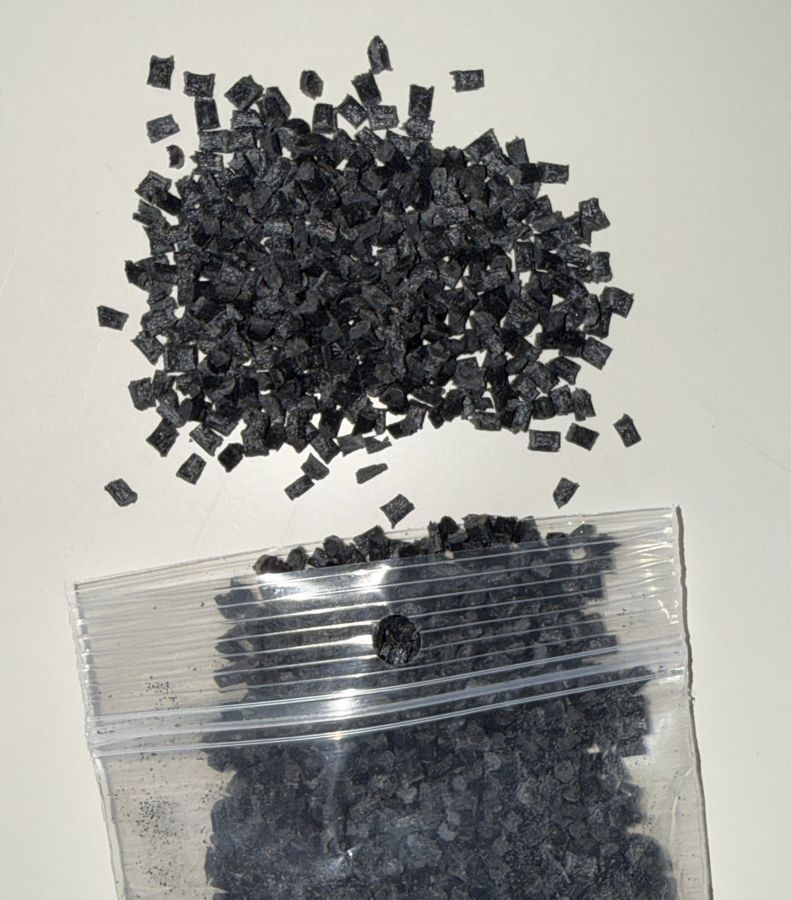 Surplus lot · Available nowPBT/PET, 55% glass-filled, black120,000 lb of prime material at 65% off typical price. A lower-moisture alternative to highly glass-filled nylon.See the lot