
Polyethylene resin supplier: wholesale PE, one gaylord to a railcar
ResinBridge is a polyethylene resin supplier for U.S. and Canadian processors. We source HDPE, LDPE and LLDPE pellets for film, coating, blow molding, injection, rotomolding and pipe, from one gaylord (about 1,000 to 1,600 lb) to a railcar. Send the grade you run, or its melt index, density and process; a polymer chemist reviews it, and we aim to quote a match or a matched alternative within one to three business days.
One gaylord to a railcar · Every prime lot from our suppliers ships with a COA
Request a QuoteShop-floor numbers
- Drying
- Not required
- Melt temp
- HDPE 190 to 260°C · LDPE 200 to 250°C
- Mold temp
- HDPE 10 to 50°C · LDPE 15 to 50°C
- Shrinkage
- HDPE 1.7 to 2.9% · LDPE: see the grade sheet
- Watch for
- Warp, gels in film, stress cracking
- Grades
- HDPE · LDPE / LLDPE (film, flexible) · Rotomolding grades · HMW and UHMW
Typical values; confirm against the grade’s data sheet. One gaylord to a railcar · Supplier COA on every prime lot · Ships to the U.S. and Canada.
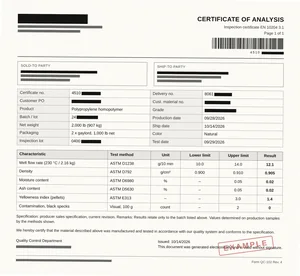 View example
See what one looks like and what to check: lot number, melt flow, density, test methods. Example shown is a PP COA; a PE COA lists melt index and density the same way. How to read a COA
Buying one type? HDPE resin supplier · HMW-HDPE · LDPE film resin supplier · LLDPE resin supplier · Metallocene PE · UHMW-PE
The short answer
Polyethylene is a family, not one resin. Density and melt index decide most of what a grade can do: HDPE for rigid parts and containers, LDPE and LLDPE for film and flexible parts, HMW-HDPE for drums, pipe and thin strong bags. The most common buying mistake is matching density and melt index but missing the comonomer, the process the grade was made for or its additive package.
Who makes polyethylene? See the HDPE, LDPE and LLDPE resin manufacturers in North America and which grades each one sells.
Grades we source
Tap a grade to add it to your quote request.
About Polyethylene (HDPE / LDPE / LLDPE)
Polyethylene is the highest-volume plastic in the world for good reason: it's inexpensive, resistant to most acids, bases, salts and alcohols, easy to process, and available in densities tuned from flexible (LDPE) to rigid and strong (HDPE).
It is attacked by strong oxidizers and swollen by aromatic and chlorinated solvents, and some grades stress-crack in contact with detergents. It's a poor barrier to gases and has low stiffness and heat resistance, so it's chosen for toughness, chemical resistance and cost rather than rigidity.
Common applications
- Bottles, drums and rigid containers
- Film, liners and flexible packaging
- Pipe, conduit and geomembrane
- Rotomolded tanks and kayaks
- Caps, closures and housewares
Typical properties
| Impact strength | High (tough) |
|---|---|
| Heat (HDT at 0.45 MPa ISO 75 / 66 psi ASTM D648) | About 45–85°C / 113–185°F |
| Clarity | Translucent-opaque |
| Chemical resistance | Excellent to acids, bases and alcohols; limited to oxidizers, aromatic and chlorinated solvents |
| Relative cost | Low |
Property ranges are general guidance and vary by grade and supplier; a polymer chemist reviews the spec against the data sheet and COA.
Full data sheet values: HDPE properties
Which grade to ask for
Use this table to find the right branch of the family, then go to the page for that grade.
| Grade type | Use it for | Watch out for |
|---|---|---|
| HDPE resin (about 0.941–0.965 g/cm³) | Crates, pails, caps and closures, housewares | Stress-crack resistance varies widely by grade. High shrinkage and warp. |
| HMW-HDPE (MI often under 0.1) | Drums, IBC bottles, pressure pipe, thin high-strength bags | Quoted by high-load melt index. Needs equipment built for high melt strength. |
| LDPE (about 0.918–0.930 g/cm³) | Shrink and clarity film, extrusion coating, the blend partner for LLDPE | Only moderate toughness on its own. |
| LLDPE, butene, hexene or octene | Liners, stretch film, heavy-duty bags, rotomolded tanks, lids | Comonomer changes dart and tear at the same melt index and density. |
| Metallocene PE and plastomers | Sealant layers, down-gauged film, impact modification | Higher head pressure and less melt strength. Often needs more antiblock. |
| Rotomolding grades (about 0.932–0.945 g/cm³, MI about 2–7) | Tanks, bins, kayaks, playground parts | Outdoor parts need a UV package. Molded as powder, so pellets have to be ground. |
| UHMW-PE | Wear strips, chute liners, machined parts | Does not flow like other PE. Supplied as powder for compression molding or ram extrusion. |
Typical starting points. Grades vary, so confirm on the data sheet for the exact grade.
Buying to a spec? See LDPE blown film resin, LLDPE film by comonomer, LDPE extrusion coating resin and HDPE blow molding resin.
Buying HDPE
For HDPE injection grades, plus blow molding, pipe, HMW and recycled HDPE in one place, see our HDPE resin supplier page and its melt index finder. This page covers the whole polyethylene family.
Polyethylene resin suppliers: who sells PE, and in what lots
Most polyethylene sold in North America comes from a short list of large producers, including Dow, ExxonMobil, Chevron Phillips Chemical, LyondellBasell, NOVA Chemicals (now part of Borouge International), Westlake, Formosa Plastics and Braskem. Their output moves mainly by railcar and bulk truck to film, bottle and pipe plants on contract, and a large share of U.S. production is exported. A processor buying PE by the gaylord or the boxed truckload usually buys through a distributor, a trader or a supplier like us.
Buying one type? HDPE has its own HDPE resin suppliers section and LLDPE has its own LLDPE resin suppliers section. The plants and brands behind each type are on polyethylene resin manufacturers in North America.
| Who you buy from | Typical order | What to expect |
|---|---|---|
| Producer | Railcar, bulk truck or truckload, mostly on contract | A contract price that often follows a monthly index, plus the producer’s COA and FDA letters. Wide-spec from the same reactors is sold separately, without the grade name. When PE is short, contract accounts get supply first. |
| Distributor | Bags, gaylords or a boxed truckload, depending on the firm | Keeps packaged stock of common film and molding PE grades, usually for one region. An authorized distributor carries the producer’s backing and paperwork. |
| Broker or trader | Mostly railcars, sometimes boxed truckloads | Much PE trading is spot railcars of prime, generic prime or wide-spec. A trader takes title to the car; a broker only arranges the sale. Ask which you are dealing with and what paperwork comes with the car. |
| ResinBridge | One gaylord to a railcar | We quote HDPE, LDPE and LLDPE through supply partners. A polymer chemist reviews every request against your MI, density, comonomer and additive needs, each quote states prime, wide-spec, surplus or recycled, and every prime lot ships with a supplier COA. |
We fit best when you need a PE grade in gaylord or truckload lots, or a second source for film, blow molding or injection grades you already buy on contract. For how title and quality responsibility differ between these sellers, see resin distributor vs. broker vs. trader.
Commonly specified PE brands and grades
| Brand or grade | Producer | What it is |
|---|---|---|
| DOWLEX 2045G | Dow | LLDPE film resin, melt index 1.0 g/10 min, density 0.920 g/cm³. DOWLEX is mostly film grades. |
| ELITE | Dow | Enhanced polyethylene resins for flexible packaging, stretch and sealant film |
| Exceed | ExxonMobil | Mainly metallocene LLDPE. During 2024 and 2025, ExxonMobil moved most former Enable grades to Exceed names. Most former Paxon HDPE grades now carry ExxonMobil HD names, with a few under Exceed HD. |
| Marlex HHM 5502BN | Chevron Phillips Chemical | HDPE blow molding resin, melt index 0.35 g/10 min, density 0.955 g/cm³. Marlex covers HDPE, MDPE, LDPE and LLDPE. |
| Petrothene, Alathon and Hostalen | LyondellBasell | Petrothene is a broad PE line; Alathon and Hostalen are HDPE lines |
| SCLAIR, SURPASS and NOVAPOL | NOVA Chemicals, now part of Borouge International | LLDPE, HDPE and some LDPE grades |
| HIFOR | Westlake | Butene and hexene LLDPE film resins |
| Formolene | Formosa Plastics | HDPE, LLDPE and LDPE |
| I’m green | Braskem | Bio-based polyethylene from sugarcane ethanol |
Send any of these names, or a grade from another producer, and a polymer chemist quotes that grade or a matched alternative. Alternatives are subject to your approval. These trade names belong to Dow, ExxonMobil and the other producers listed, and listing them does not imply a partnership with any of them. More PE names and equivalents: the resin grade cross-reference and the plastic trade name decoder. If your part does not need a named prime grade, see wide-spec polyethylene and recycled HDPE pellets.
Grade finder: start from what you make
Pick your process, find the row for your product, and tap Request a Quote to add it to the form.
| Product | Grade family | Typical window | Put on the RFQ | Quote |
|---|---|---|---|---|
| Can liners, trash bags and heavy-duty sacks | LLDPE, butene or hexene, often blended with LDPE or recycled PE | MI about 0.5–1 g/10 min (190°C / 374°F, 2.16 kg); density about 0.917–0.922 g/cm³ | The comonomer (butene for economy liners, hexene for sacks and tougher liners), and dart (ASTM D1709) and tear (ASTM D1922) targets at your gauge. LLDPE film by comonomer › | |
| Stretch film (cast) | LLDPE, hexene or octene, or metallocene LLDPE | MI about 2–4 g/10 min (190°C / 374°F, 2.16 kg); density about 0.916–0.920 g/cm³ | Cast or blown, and whether the cling additive is in the resin or added at the line. LLDPE film by comonomer › | |
| Shrink and bundling film | LDPE, fractional melt index | MI about 0.2–0.8 g/10 min (190°C / 374°F, 2.16 kg); density about 0.918–0.923 g/cm³ | Melt strength for shrink, and the gel limit you accept. LDPE blown film resin › | |
| Bread, produce and clarity bags | LDPE general-purpose or clarity film grade | MI about 1.5–2.5 g/10 min (190°C / 374°F, 2.16 kg); density about 0.918–0.924 g/cm³ | Slip and antiblock type and level (or none), and the producer’s FDA letter for food bags. LDPE blown film resin › | |
| Grocery, T-shirt and merchandise bags | HMW-HDPE film grade, usually bimodal | HLMI about 5–12 g/10 min (190°C / 374°F, 21.6 kg); density about 0.946–0.952 g/cm³ | A film grade made for high-stalk blown film, and whether you blend in LLDPE or recycled content. HMW-HDPE › | |
| Sealant and down-gauged film layers | Metallocene LLDPE or plastomer | MI about 0.5–1.5 g/10 min (190°C / 374°F, 2.16 kg); density about 0.912–0.918 g/cm³ (plastomers about 0.900–0.910) | Seal initiation temperature and hot tack, plus the antiblock level, since these grades block more. Metallocene PE › | |
| Paperboard cups, cartons and foil or film lamination | LDPE extrusion coating grade, usually autoclave | MI about 4–12 g/10 min (190°C / 374°F, 2.16 kg), some lamination grades higher; density about 0.918–0.925 g/cm³ | No slip or antiblock, low odor and taste, and the producer’s FDA letter. LDPE extrusion coating resin › | |
| Dairy, juice and water jugs | HDPE homopolymer blow molding grade | MI about 0.3–0.8 g/10 min (190°C / 374°F, 2.16 kg); density about 0.960 g/cm³ or higher (check the grade sheet) | Homopolymer, low odor and taste, and the producer’s FDA letter. HDPE blow molding resin › | |
| Detergent, bleach and household chemical bottles | HDPE copolymer blow molding grade | MI about 0.2–0.4 g/10 min (190°C / 374°F, 2.16 kg); density about 0.953–0.956 g/cm³ | ESCR by ASTM D1693 with the condition (B is common), the reagent and its strength, and the F50 hours, or bottle ESCR by ASTM D2561. Also unimodal or bimodal. HDPE blow molding resin › | |
| Drums, IBC bottles and large containers | HMW-HDPE large-part blow molding grade | HLMI about 2–10 g/10 min (190°C / 374°F, 21.6 kg); density about 0.945–0.954 g/cm³ | HLMI with its load, and whether a resin change affects the UN packaging approval on the container. HMW-HDPE › | |
| Pails, crates and totes | HDPE injection grade | MI about 4–8 g/10 min (190°C / 374°F, 2.16 kg); density about 0.950–0.960 g/cm³ | ESCR and cold impact, and a UV package for crates stored outdoors. HDPE injection grades › | |
| Caps and closures | HDPE closure grade, often bimodal | MI about 0.5–2 g/10 min (190°C / 374°F, 2.16 kg) for carbonated drink closures, about 1.5–8 for still-water, juice and dairy caps, and up to about 20 for general screw caps; density about 0.950–0.960 g/cm³ | Slip agent type and level (it sets removal torque), ESCR, and low odor and taste for beverages. Caps and closures resin › | |
| Flexible lids and thin-wall housewares | LLDPE injection grade | MI about 20–50 g/10 min (190°C / 374°F, 2.16 kg); density about 0.919–0.930 g/cm³ | Flexibility and impact at freezer temperature, and the producer’s FDA letter for food lids. LLDPE › | |
| Tanks, bins, kayaks and playground parts | Rotomolding LLDPE or MDPE; HDPE rotomolding grades for stiff bins and feeders | MI about 2–7 g/10 min (190°C / 374°F, 2.16 kg); density about 0.932–0.945 g/cm³, HDPE grades up to about 0.948 | A UV package rated for outdoor life, and pellets or ground powder (often 35 mesh, about 500 µm). Rotomolding resin › | |
| Water and pressure pipe | Bimodal HDPE pipe compound, PE4710 / PE100 | MI under 0.15 g/10 min (190°C / 374°F, 2.16 kg) (ASTM D3350 cell 4), so grades are usually quoted by HLMI (190°C / 374°F, 21.6 kg); base-resin density above 0.947 and up to 0.955 g/cm³ (cell 4). Black compound reads higher, about 0.959–0.961 | Material designation, full ASTM D3350 cell class, PPI TR-4 listing, and NSF/ANSI/CAN 61 for potable water. Pipe and conduit › | |
| Conduit, innerduct and corrugated drainage pipe | HDPE pipe or conduit grade | MI about 0.15–1 g/10 min (190°C / 374°F, 2.16 kg); base-resin density about 0.947–0.955 g/cm³ | The ASTM D3350 cell class your pipe standard calls for (for example 435400C for 12–60 in. corrugated pipe to AASHTO M294, 424420C for 3–10 in. to AASHTO M252), and whether recycled content is allowed. Pipe and conduit › | |
| Extruded sheet and thermoformed liners | HMW-HDPE or HDPE sheet grade | HLMI about 5–15 g/10 min (190°C / 374°F, 21.6 kg); density about 0.945–0.953 g/cm³ | UV stabilizer or carbon black for outdoor sheet, and the thickness range you run. HMW-HDPE › | |
| Geomembrane and pond, landfill or canal liners | MDPE or HDPE geomembrane resin, with carbon black added as masterbatch or precompounded | MI under 1.0 g/10 min (190°C / 374°F, 2.16 kg); base-resin density about 0.932 g/cm³ or higher, so the black sheet reaches at least 0.940 g/cm³ (GRI-GM13) | The liner spec you must meet (GRI-GM13 for HDPE, GRI-GM17 for LLDPE), carbon black at 2.0–3.0% and who adds it, and an antioxidant package that passes the spec’s OIT limits. HDPE properties › | |
| Color and additive masterbatch carrier | LLDPE or LDPE carrier, pellets or powder | MI about 20–50 g/10 min (190°C / 374°F, 2.16 kg); density about 0.918–0.926 g/cm³ | Pellet or powder, and a carrier that suits the resin your customers let down into. Compounders and masterbatch › |
The MI and density windows above are typical published ranges for each use. Check them against the data sheet for the PE grade you run, and have a chemist review any alternative before you switch.
Processing notes
- Drying. Not required. PE picks up surface moisture only. Use warm air to remove condensation if cold pellets come into a warm plant.
- Melt temperature. For injection molding, HDPE runs 190 to 260°C / 374 to 500°F and LDPE 200 to 250°C / 392 to 482°F. Film, blow molding and pipe lines are set from the grade's data sheet. Use these ranges only as an outer check.
- Mold temperature. HDPE 10 to 50°C / 50 to 122°F, LDPE 15 to 50°C / 59 to 122°F. Producers disagree on whether HDPE should run cold for cycle time or warmer for flatness. Both can be right for different parts.
- Shrinkage. HDPE about 1.7 to 2.9%, among the highest of any injection resin. LDPE and LLDPE shrinkage varies by grade, so take the value from the grade’s data sheet. Parts keep shrinking for a day or two after molding, so measure late.
- Regrind. 20–30% is a common start for HDPE, 10–30% for LDPE and LLDPE, where film edge trim is often fed straight back. Unlike most resins, PE can crosslink slightly with heat history instead of thinning out, which shows as gels.
- Most common defect, by process. Warp in molded parts, gels in film and stress cracking in containers that hold detergents. See gels in film and stress cracking.
How polyethylene prices are set
Most polyethylene in North America sells on contract. A processor agrees on volume with a producer or distributor, and the price moves each month. Producers send letters that nominate an increase (or, less often, a decrease) by a set amount per pound from a set date. Whether it settles in full, in part or not at all depends on supply, demand and feedstock that month. PE contract moves are tracked by S&P Global Energy (Platts, formerly S&P Global Commodity Insights), ICIS (which owns Chemical Data, or CDI), OPIS and consultants such as Resin Technology Inc. (RTi). Their reports split PE into grade families such as HDPE blow molding, HDPE injection, LDPE film and LLDPE butene film, and say how much each one moved. Many contracts are written as that index plus or minus a negotiated differential. Spot PE, often railcars of prime, generic prime or wide-spec, trades outside those contracts and moves faster up and down. The Plastics Exchange publishes reports on that spot trading.
What moves the price: in the U.S. most ethylene is cracked from ethane, a natural gas liquid, while Europe and much of Asia crack naphtha from crude oil. That gives U.S. producers a cost edge, so a large share of U.S. production is exported, and export demand and ocean freight pull on domestic prices. New Gulf Coast capacity pushes prices down. Plant outages, Gulf Coast hurricanes and hard freezes can take large blocks of capacity offline at once and pull them up fast.
A warning about search results: when you search for HDPE price per pound, many of the numbers you find are recycled bale prices. A bale is sorted but unwashed post-consumer bottles, compressed at a recycling facility before washing and pelletizing. It is not resin you can run, and it moves on a different cycle from prime pellets. Recycled pellets (PCR) are priced separately again, and food-grade PCR can cost more than prime.
We do not post PE prices. A quote covers one grade, in one quantity and package, delivered to or picked up for one ship-to city. See how resin is priced for the mechanics and the resin market notes for which way PE is moving this month.
Cheaper polyethylene resin: ways to lower the price per pound
If price matters more than a named grade, these options move the number most:
- Accept wide-spec or near-prime. Producer-made resin outside a grade’s published window sells below prime. It suits black or dark molded goods, pallets, trash bags and some film blends, not food contact, listed pipe or customer-approved parts. See wide-spec polyethylene.
- Order a fuller load. Freight per pound falls sharply from one gaylord to a full truckload, as the table below shows.
- Allow an equivalent grade. Accepting generic prime or another producer’s grade with the same melt index and density widens the supply you can buy from. Qualify it first; see adding a second source.
- Use repro or PCR where the part allows it. Reprocessed PE often costs less than prime for dark, non-critical parts. Food-grade PCR can cost more than prime.
- Watch the market. Spot material moves faster than contract prices in both directions; the resin market notes show which way PE is heading.
Whichever you choose, get a lot COA or measured values and run a sample before a production order.
What order size does to the price
| How you buy | Typical size | Why the price per pound differs |
|---|---|---|
| Hopper railcar | About 180,000–210,000 lb | The lot size PE contract and index prices are closest to. No boxes and the lowest freight per pound, but the plant needs a siding and silos, or a transload terminal nearby. |
| Bulk truck (pneumatic hopper) | About 40,000–50,000 lb | Common for film and blow molding plants with silos. Often a railcar reloaded at a terminal, so a handling charge is added over the rail price. |
| Boxed truckload (gaylords) | About 40,000–45,000 lb: roughly 26–30 gaylords of 1,500 lb or more, with lighter boxes double-stacked to reach full weight | Boxes, liners and pallets add cost, but a full truck keeps PE freight per pound low. The usual step up for molders and converters without silos. |
| LTL or partial truckload gaylords | 2 to about 18 gaylords | Each pound carries several times the freight of a full truck, plus terminal handling, liftgate and fuel surcharges. |
| Single gaylord | About 1,000–1,600 lb | The highest freight per pound for boxed PE, and the fixed cost of an order (paperwork, COA, credit, handling) lands on one box. Best for a trial or a short run. |
| Small boxes or bags | 55 lb (25 kg) bags or boxes | The highest price per pound, since packaging and handling make up much of it. Mostly for samples and lab work. |
For PE, lot size is only one lever. Freight to your dock, FOB or delivered terms, imported or domestic resin and prime or wide-spec can move the price as much, so include your ship-to city with every request.
If the part allows it, surplus lots and recycled PE grades are two more ways to cut cost beyond the list above. See how resin is priced.
Packaging and lead times
| Package | Typical net weight | Notes |
|---|---|---|
| Bag | 55 lb (25 kg) | Commonly about 40–55 bags per pallet. Mostly samples, lab work and specialty PE grades. |
| Gaylord (box with liner) | About 1,000–1,600 lb | Depends on bulk density and box height. HDPE packs a little heavier than LDPE in the same box. Check net weight on the quote. |
| Bulk bag | About 1,000–2,200 lb | Takes a bag unloader or discharge frame. Uses less floor space and cardboard than gaylords. |
| Bulk truck | About 40,000–50,000 lb | Blown into your silo. Film and blow molding plants with silos often take PE this way. Match the seal numbers to the bill of lading. |
| Hopper railcar | About 180,000–210,000 lb | Large film and pipe plants often buy PE this way. You need a siding or a transload, and demurrage charges start once the car sits past the railroad’s free time. |
We confirm lead time on the quote and give a ship date only after the source confirms it. For PE the main question is where the grade sits. Common film and molding grades already boxed in a supplier warehouse usually ship first. A less common grade, or one you want in a different package, waits for the producer’s next run of that grade, which can take weeks. A railcar adds rail transit time, which depends on the lane.
Gulf Coast hurricanes, hard freezes and plant outages can put PE grades on allocation or force majeure. Contract accounts are served first, spot PE gets scarce, and lead times stretch. Tell us your need-by date and how much you have on hand, and we will tell you what is realistic. See what to do under allocation or force majeure and gaylord vs. LTL vs. truckload.
What to put on the purchase order
- Density and melt index, with methods. Density by ASTM D1505 or D792. Melt index by ASTM D1238 at 190°C / 374°F and 2.16 kg, or high-load melt index at 21.6 kg for very low-MI grades.
- Comonomer and structure. Butene, hexene, octene or metallocene for LLDPE. Unimodal or bimodal for HDPE.
- The process the grade was made for. Film, blow molding, injection, rotomolding or pipe. Two grades with the same numbers from different process families can carry different additives and run differently.
- Additive package. Antioxidant, slip and antiblock, processing aid (fluorine-free if your customer requires it) and UV stabilizer.
- ESCR for containers and closures. The value, the test method and the condition, so you compare like with like.
- Food or pharma use. Ask for the producer's FDA letter for the exact grade. PE letters usually cite 21 CFR 177.1520.
- Prime or off-grade. Say which you will accept. See prime vs. off-grade resin. PE pellets run about 31–37 lb/ft³, so check net weight per gaylord on the quote.
Prime, wide-spec, reprocessed or recycled
| Material | What it is | When it makes sense | What to ask for |
|---|---|---|---|
| Prime | First-quality PE from the producer, inside the grade’s published window and sold under the grade name with a lot COA. | Film, bottles and parts with a spec or customer approval, listed pipe, UN-marked containers and food contact. | The grade name, a lot COA, and for food use the producer’s FDA letter (PE letters usually cite 21 CFR 177.1520). |
| Wide-spec | PE the producer could not sell under the grade name because MI, density, color or gel count fell outside the published window. | Non-critical film, liners and molded parts that tolerate some variation, often bought by the railcar. | Which property is off and by how much, measured values for each lot, and the additive package if known. |
| Off-grade or near-prime | Material made while the reactor moves between grades, so MI and density drift across the lot, or lots with a defect. Near-prime is close to spec. | Trash bags, black molded goods and other price-driven items where every lot can be tested and blended in. | MI and density range, a gel and contamination check, and a sample before you buy the lot. |
| Reprocessed (repro) | PE production scrap, such as film trim or molding regrind, that has been melted, filtered and pelletized again. | Black or dark parts, non-pressure pipe and products that allow a set share of repro. | The source stream, MI range lot to lot, screen mesh, color and odor. |
| PCR | Post-consumer recycled: bottles, film or other used packaging that has been sorted, washed and pelletized. | When a brand owner or a state packaging law requires post-consumer content in bottles, film or bags. | Bottle or film source, MI and density window, gels and odor. For food contact, ask for FDA’s letter of no objection (NOL) covering the recycler’s process. FDA issues an NOL for a process and its stated conditions of use rather than per lot, so confirm this lot came from that process. See recycled resin. |
| PIR | Post-industrial recycled: clean scrap from manufacturing that never reached a consumer. | Recycled content with more consistency than PCR. | Where the scrap came from (film trim, for example), and whether your customer’s recycled-content target counts PIR. See prime vs. off-grade. |
Checking the COA when the lot arrives
- Lot number. Match the COA lot to the label on each gaylord or bag. For a bulk truck or railcar, match the seal numbers to the bill of lading.
- Melt index by the right condition. MI at 190°C / 374°F and 2.16 kg is inside your window. For HMW grades, check HLMI at 21.6 kg. A 21.6 kg value cannot be compared with a 2.16 kg spec.
- Density. Inside your window by ASTM D1505 or D792. Small shifts move stiffness and ESCR. For black pipe compound, know whether the value is base resin or compound, since carbon black raises density.
- Grade and additive package. The grade name matches your PO, and slip, antiblock, antioxidant and processing aid have not changed. Producers do reformulate, for example when moving to fluorine-free processing aids.
- Gels and color for film. If the grade reports gel count or color, check them. Run a short film trial and look for gels before you commit the whole lot.
- ESCR for containers. ESCR is often a typical value, not a lot test. If your bottles depend on it, ask whether it is tested per lot, or test it yourself by ASTM D1693.
- Pellets and packaging. Look for torn liners, water and dust. PE pellets are soft enough to form streamers (angel hair) in pneumatic conveying, so check bulk loads for fines and streamers.
- Keep a retain. Bag and label a small sample from every lot, so a later film or bottle complaint can be traced back to the resin. See the incoming inspection checklist and what a COA is.
Adding a second source without stopping the line
- Record the current PE grade. Its data sheet, three to six recent COAs with real lot values, your line settings, and every approval tied to it: FDA letter, pipe listing, UN mark or customer sign-off.
- Match on paper first. A polymer chemist compares MI and density with their test conditions, comonomer, catalyst, unimodal or bimodal structure, additives and documents, and tells you what differs.
- Lab sample, then a production trial. Test a sample first, then run one gaylord on a normal shift beside the current grade. Use the PE tests you already rely on: dart and tear for film, ESCR and top load for bottles, warp for molded parts.
- Requalify before volume. Listed pipe, UN-rated containers and customer-approved parts need fresh approval. That paperwork usually takes longer than the trial, so start it early.
- Keep the second grade in use. Order a small amount on a regular schedule and trend the COAs, so the second PE grade is ready if your main one goes on allocation. See how to qualify a second resin source.
To have a chemist compare a second PE grade with your current one, send the grade name and recent COAs through the quote form or an RFQ package.
When to consider something else
- If you need more heat resistance or a living hinge, look at PP: PP vs. HDPE.
- If abrasion and sliding wear are the problem, look at HDPE vs. UHMW.
- If you need a softer, more elastic film or foam, or better adhesion to other materials, look at EVA. For foam, see EVA foam resin.
- If your customer requires recycled content, see recycled resin and processing PCR resin. For HDPE, see recycled HDPE pellets.
Common questions
What is the difference between HDPE, LDPE and LLDPE?
It comes down to branching. HDPE has almost straight chains that pack tightly, so it is dense, stiff and strong. LDPE has long branches that keep chains apart, which makes it soft and easy to process. LLDPE has short, regular branches from a comonomer, which gives tough, puncture-resistant film. See HDPE vs. LDPE and LDPE vs. LLDPE.
Is polyethylene food safe?
Many PE grades are made for food contact, but compliance is set grade by grade. Ask for the producer's FDA letter for the exact grade and check the conditions of use it states. Additives, colorants and recycled content you add need their own documents.
Does polyethylene need to be dried?
No. PE does not absorb water, so drying is not required. The only exception is condensation: pellets moved from a cold trailer into a warm plant can sweat, and a short pass of warm air removes it.
Can I mix HDPE and LDPE?
Yes, they melt and blend readily, and film lines blend PE types all the time. In molded parts a blend changes stiffness, shrinkage and stress-crack resistance, so treat any blend as a new material and test it. Keep track of melt index too: a large gap between the two can leave unmelted gels.
Is LDPE the same as polyethylene?
LDPE is one type of polyethylene. Polyethylene is the family; LDPE (low-density polyethylene) is the type with long side branches, which make it soft, clear and easy to process. HDPE and LLDPE are the other main types. See LDPE vs. LLDPE and HDPE vs. LDPE.
What is the price of polyethylene per pound?
There is no single PE price to post. Polyethylene prices move month to month with feedstock, producer increases and exports, and your price also depends on the grade, quantity, packaging and freight to your dock. Many HDPE price per pound search results are recycled bale prices, which are not pellets you can run. See the resin market notes for which way PE is heading, and send your grade, quantity and ship-to city for a firm quote.
What is the minimum order for polyethylene?
One gaylord of PE, about 1,000 to 1,600 lb depending on the grade’s bulk density, with no truckload minimum. A sample of about 50 lb for qualifying a production grade is available upon credit approval.
How long does polyethylene take to arrive?
Common film and molding grades already boxed in a warehouse ship soonest. A grade that has to wait for the producer’s next run, or one on allocation after an outage, takes longer. We confirm lead time on the quote, and we aim to send quotes within one to three business days.
What is the difference between FOB and delivered pricing?
FOB names a point, usually the warehouse or railcar origin, and freight from there to you is extra. Delivered means the price already includes freight to your dock. Risk in transit follows the terms written on the quote, so read them, and compare PE quotes on delivered cost per pound.
Can I get the same grade from a different producer?
Not the identical grade, since each producer’s grades are their own, but close alternatives exist for most PE. Matching MI and density is not enough: comonomer, catalyst, molecular weight distribution and additives can make two grades run and test differently. A polymer chemist checks those against your grade, and anything tied to a listing, UN mark or customer approval needs requalification.
Are you a polyethylene distributor?
No. We are a resin supplier, not a PE producer or an authorized distributor for Dow, ExxonMobil or any other producer. We quote HDPE, LDPE and LLDPE through our supply partners from one gaylord (about 1,000 to 1,600 lb) to a railcar. A polymer chemist reviews every request, and every prime lot ships with a supplier COA. See resin distributor vs. broker vs. trader.
Related pages (26)
Talk to a polymer chemist
Have a grade on a print, a bag label, or just a part you need to make? Send what you have.
- Send the grade, a callout or a photo of the bag label.
- We check it, and suggest a matched alternative if it is hard to get.
- We aim to quote within one to three business days, from one gaylord to a railcar.
Tell us the Polyethylene grade you run now
A polymer chemist reviews every request, then matches your grade or finds a matched alternative and prices it.
What to send for an accurate quote
- The grade name, from any supplier, or a data sheet
- Color (natural, black or a custom match)
- The process (blown film, cast film, molding)
- Melt flow, if you know it
- Quantity for this order and what you use in a year
- Ship-to ZIP or postal code